
If you’re planning things to do in Genoa, Italy, you must be a savvy traveler!
Genoa (known as Genova in Italian) is a fascinating city with a long and rich history. Unfortunately, it typically gets overlooked in favor of other places along the sea or cities in northern Italy. I visit Genoa often and always come away with learned secrets about the city, as well as new mysteries to work on for next time.
Not to worry though, even with just a day or two, you can experience the best of Genoa.
In this guide, I’ll show you what to see in Genoa Italy, give important planning tips, explain the best ways to get here, and offer advice on booking the right Genoa hotel.
Are you ready to uncover all that is Genoa? Andiamo!
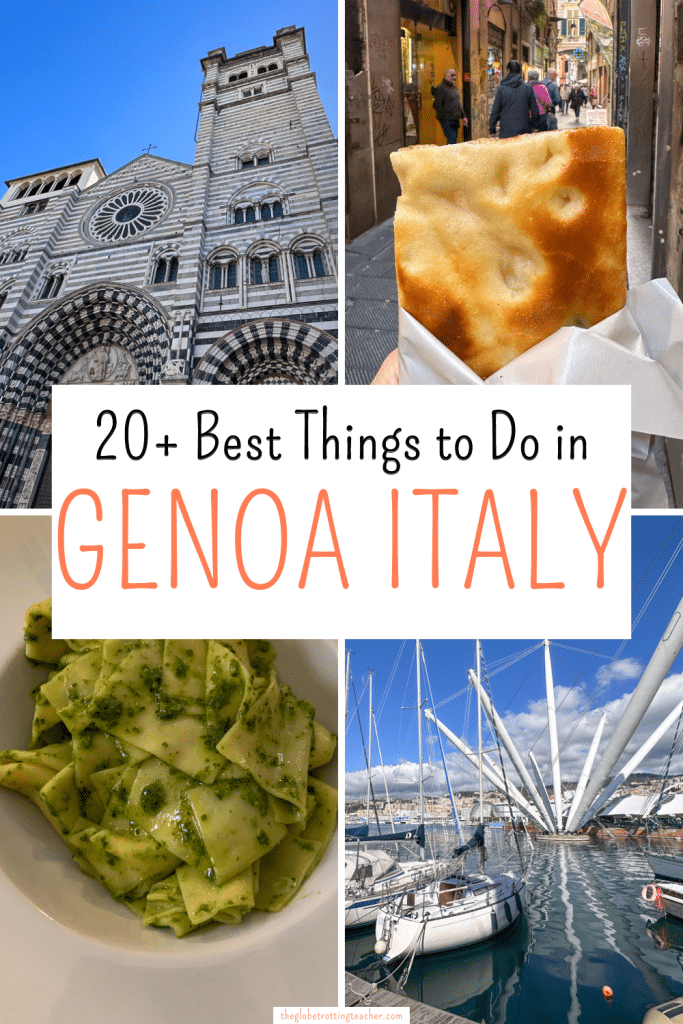
Where is Genoa, Italy?
Genoa is the coastal capital city of the northern Italian region of Liguria. The city sits between the Ligurian Alps and the Mediterranean Sea. The medieval name of Genoa is Janua, which derives from the Latin word for “door”, indicating its historic role as a crossroads between different people and cultures, as well as an important Middle Ages trading port.
Genoa is centrally located within Liguria. The popular Italian Riviera with places like Portofino and the Cinque Terre is to the southeast. The “quieter side” of Liguria and the French border are to the southwest. The regions of Piedmont and Lombardy are north of Genoa and Liguria while Emilia-Romagna is to the east.
The Genoa map below shows where the city lies in Italy, as well as where the top things to do in Genoa are. For a fuller look at the entire region, use this Liguria map to orient yourself and plan your visit.
Map of Genoa Italy
How to Get to Genoa
Genoa Airport is located less than 5 miles from the city center. There is a convenient airport shuttle (Volabus) that you can take to arrive in the city which takes about 30 minutes. A taxi ride will take about half that time depending on traffic.
Genoa’s AMT public transportation system offers a 24-hour card for just 10 Euros that can be used throughout the city’s trains, buses, elevators, and funicular railways. The Volabus shuttle is included with this ticket. The information can be verified and the card purchased here.
If you’re arriving from other Italian cities, your best option is to take the train to Genoa’s main station, Piazza Principe. From Milan, the train ride will be 1 hour and 30 minutes by high-speed train. From Turin, the ride is as fast as 1 hour and 40 minutes.
If you’re arriving in Genoa from Bologna, there isn’t a direct train. You’ll have to take a train to Milan first, and then connect for another one to Genoa.
If you’re driving, Genoa is well-connected via Italy’s autostradas. You can easily get here from the regions of Piedmont, Lombardy, and Emilia-Romagna. Understand that Genoa is a busy city and driving here can be stressful. Confirm with your hotel if they offer parking before arriving. If they do, navigate directly there to avoid any mixups.
Parking isn’t easy in Genoa and there are many ZTLs, or traffic limitation zones. If you’re driving and planning to stay just for the day, I recommend navigating to one of the parking areas along the Porto Antico, like this one, and setting off on foot from there. There are several “parcheggios” along this stretch so if you pull into one before or after, that’s ok too.
Good to Know: Genoa is what we call the city in English but the name in Italian is Genova. City and road signs will all say Genova so be aware that it’s one and the same city.
Is Genoa Worth Visiting?
I completely understand if you’re wondering whether or not Genoa deserves a spot on your Italy itinerary. You could spend a month in just northern Italy and not see and do everything!
But even with this, a visit to Genoa is worth it. I’ve visited Genoa several times (and counting…) and each time I find myself planning my next visit. Genoa has an allure. There’s simply no other city like it in Italy.
Genoa is a wonderful mix of past and present, beauty and grit. The pulse of the city flows from its seaport as it has for more than 1000 years when it was the capital city of a maritime republic.
Today, the Port of Genoa has been revitalized to welcome visitors while still honoring how central the sea was to the city’s development and power. You’ll find museums, the largest aquarium in Italy, replicas of historic ships, and a promenade lined with palmed trees to stroll and watch the hive of activity around the old port turned new again.
In the centro storico, you can admire the noble palaces that once belonged to wealthy merchant families and ancient churches, as well as get lost in the caruggi. These tiny alleyways were built like a labyrinth to protect the city from potential seafaring invaders who would quickly find themselves ensnared in the web of layers that make up the city.
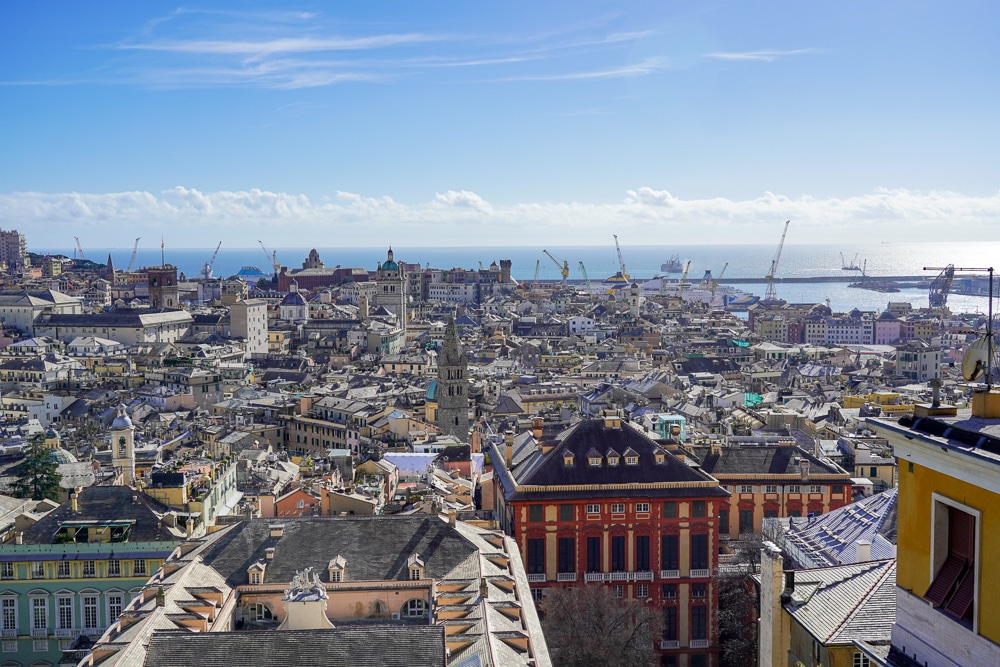
The grandiosity of Genoa’s past is still visible in the city’s porticoed sidewalks and colorful, colonnaded buildings. Explore further and you’ll find yourself climbing upward just as Genoa has as it’s grown into a modern city. It’s from these upper parts that sit in seemingly delicate positions on the amphitheater-shaped hillside that you can swoon over the incredible city and Mediterranean Sea views.
Nicknamed La Superba, “the proud one” by the Italian Renaissance poet Petrarch, a trip to northern Italy is not complete without a visit to Genoa!
Best Things to Do in Genoa Italy
Visitors to the city mainly focus on 2 areas within Genoa, the Centro Storico (historic city center) and the Porto Antico (the city’s seaport). Within these areas of the city, you’ll find most of the most popular things to see in Genoa. I’ve broken them down by area below.
Explore the Centro Storico.
Genoa is an old city. We’re talking 1000 years ago was the start of its dominant reign as a republic and trade powerhouse and at least 1000 years before that different groups of people settled in what is present-day Genoa.
If you enter the old town from its eastern side, you’ll come across the city’s only remaining ancient entrance gate, Porta Soprana. It sits next to the relocated ruins of St. Andrew’s Cloister. Both of which date back more than 800 years and are worth a look.
What amazed me was how well-preserved the towers of Porta Soprana were for their age. They’re quite impressive and from the inside, you can climb up for a birds-eye view.
Just nearby, you’ll find the Christopher Columbus House, a rebuilt medieval house where Columbus lived with his family as a boy. It’s tiny and has some information showing the lineage of Columbus’ family and proof that he was from Genoa.
Wander into the Caruggi.
The heart of Genoa’s historic center is made up of a maze-like web of medieval alleyways called caruggi. As you move away from the Porto Antico and into the old town, you’ll see these alleyways stemming from the larger streets.
You can admire some of the most fascinating caruggi by crossing away from the seaport and finding your way into the streets between the water and sights like the Cathedral of San Lorenzo and Piazza de Ferrari. With seemingly no sense or pattern, the caruggi intersect randomly and then just as haphazardly open into a small piazza.
During the day, you’ll find plenty of people wandering through these narrow streets, so not to worry. Along the way, you’ll find local markets, focaccerias, shops, restaurants, and hidden-way churches. I do recommend avoiding the caruggi at night for safety reasons. Plus, it could be hard to find your way out if you’re not confident about where you’re going.
Admire the Cattedrale di San Lorenzo.
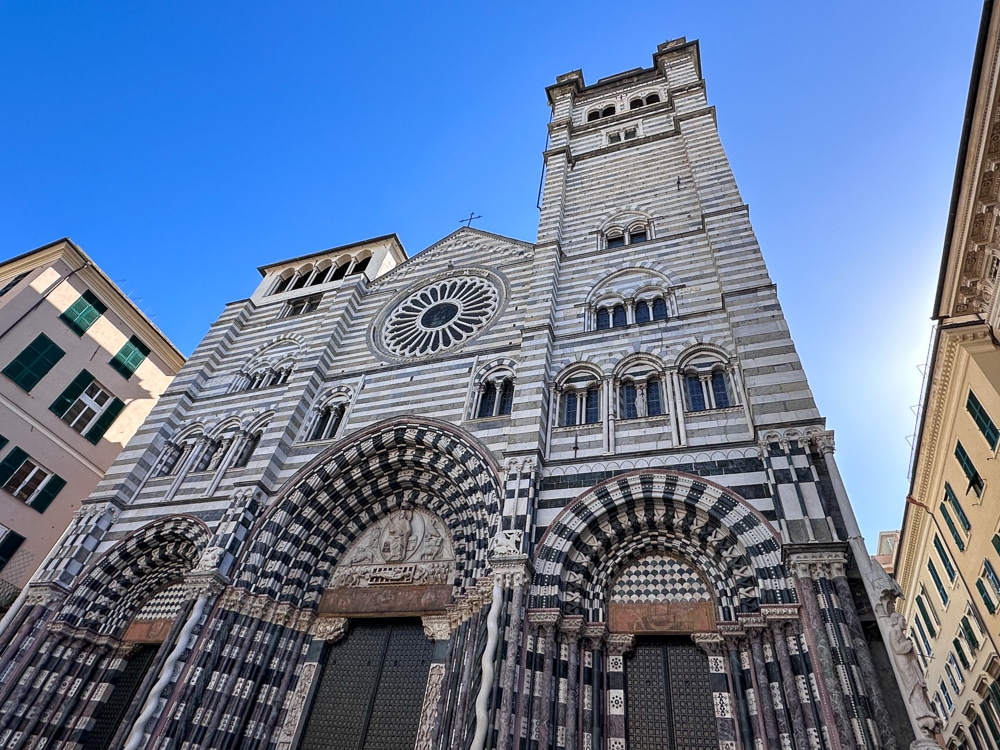
A can’t-miss thing to see in Genoa is the Centro Storico’s Cathedral of San Lorenzo, also known as the Genoa Cathedral. Construction started on the Cathedral in the 12th century and continued into the 1600s as additional naves, the bell tower, and a dome were added. Overall, the Cathedral blends a medieval design with Romanesque elements and a Gothic facade.
But even if you don’t have an eye for identifying architectural styles, the Cathedral has a WOW factor from the moment you see it. From the facade into the Cathedral itself, the black and white striped pattern strikes me every time!
Looking past the stripes, you’ll also notice how stunning the frescoes are! Look for the chapel of San Giovanni Battista, where the saint’s ashes are said to be preserved.
And perhaps one of the most unexpected sights is on the right side of the church near the main doors. You’ll find an unexploded World War II shell. No need to worry, though. It’s actually a replica but it marks the actual events which took place in February of 1941 when the shell came through the roof of the church and thankfully didn’t explode.
Visit Piazza de Ferrari.
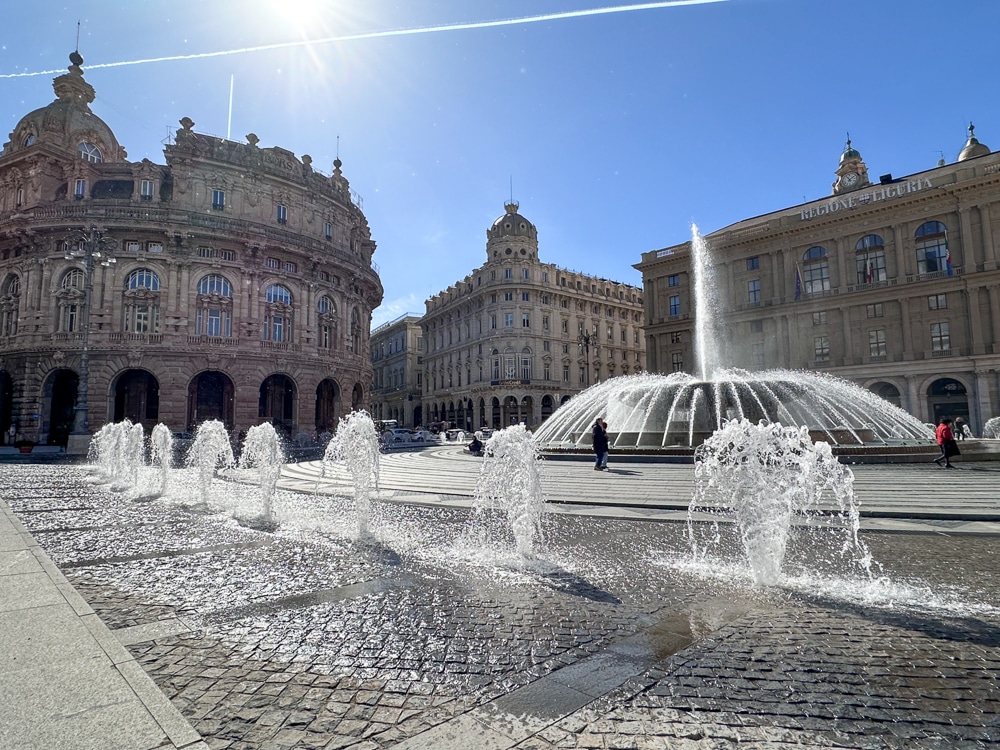
With its iconic fountain and central location, you can’t miss seeing Genoa’s main piazza. It’s a hub from a design standpoint, with several main streets stemming from the center of the square. Piazza de Ferrari is also the heart of the city’s commercial district with many company offices filling the surrounding buildings.
But from an architectural standpoint, the square is striking! The neo-classical buildings combined with the modern buzz of the square blend perfectly together. It’s one of the best spots to snap a photo of this underrated northern Italian city before taking a stroll down Via XX Settembre.
Walk along Via XX Settembre.
Stretching between Piazza de Ferrari and Piazza della Vittoria, Via XX Settembre is one of Genoa’s main streets and a sight all unto itself. It’s lined with majestic art nouveau architecture while the porticoed sidewalks have beautiful mosaic tiles and ornate ceilings. At just over half a mile, it’s easily one of the grandest streets you’ll walk along in northern Italy.
The street is lined with shops, cafes, and markets including the Mercato Orientale where you can buy fresh and prepared foods. You’ll also pass under the historic Monumental Bridge (which has been under renovation for a while). It’s easy to get wrapped into the grandiosity of the scene while hopping in and out of shops but be sure to also pay attention to the beautiful adornments on the buildings.
Check out Beautiful Palazzo Ducale (Doge’s Palace).
Between the Cathedral and the Piazza de Ferrari, the neoclassical Doge’s Palace now houses a museum and cultural space. Historically, it was used for the elected leader of the Republic of Genoa.
Either way, the palace is huge and stunning. The exhibitions and events change regularly so it’s best to visit the main website to see what’s happening when you visit. The exhibitions use the palace space so as you enjoy the exhibit, you’ll also get to marvel at the palace’s incredible beauty. I highly recommend it as a top thing to do in Genoa.
Don’t Miss the Palazzo Reale (Royal Palace)!
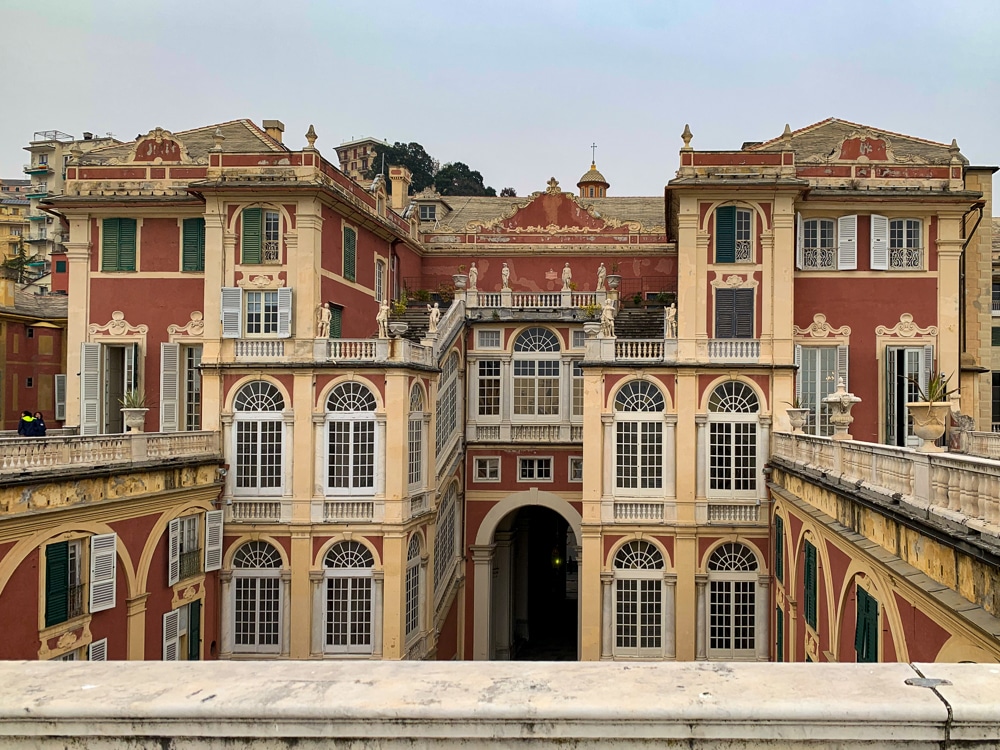
The Royal Palace of Genoa is located inside the palace also known as Palazzo Balbi and it’s one of the top Genoa places to visit. This magnificent palace has a long history going back to the early 17th century when it was built by the Balbi family. Today, it’s still a stunner and has been recognized as a UNESCO World Heritage Site.
In 1677, the palace passed to Eugenio Durazzo who transformed it into a majestic baroque building. He’s credited with the addition of the East Wing and the beautiful terrace, among many other renovations. In 1824, the Savoys, Italy’s ruling royal family before the country unified into a Republic, acquired the palace and made it their residence in Genoa. This is why it’s also known as the Royal Palace.
While the Royal Palace in Turin may have more overall opulence, the Royal Palace in Genoa is incredibly beautiful and has maintained impressive original pieces of furniture and artwork. Inside, you’ll find paintings by Van Dyke and Tintoretto and priceless frescoes and sculptures.
Aside from the artwork, I was amazed by the Hall of Mirrors and the Royal Palace’s terrace and courtyard with beautiful harbor views. Even if you’re in Genoa for just a day, visiting the Royal Palace should be at the top of your list.
Be Wowed by Le Strade Nuove and the System of the Palazzi dei Rolli (Rolli Palaces).
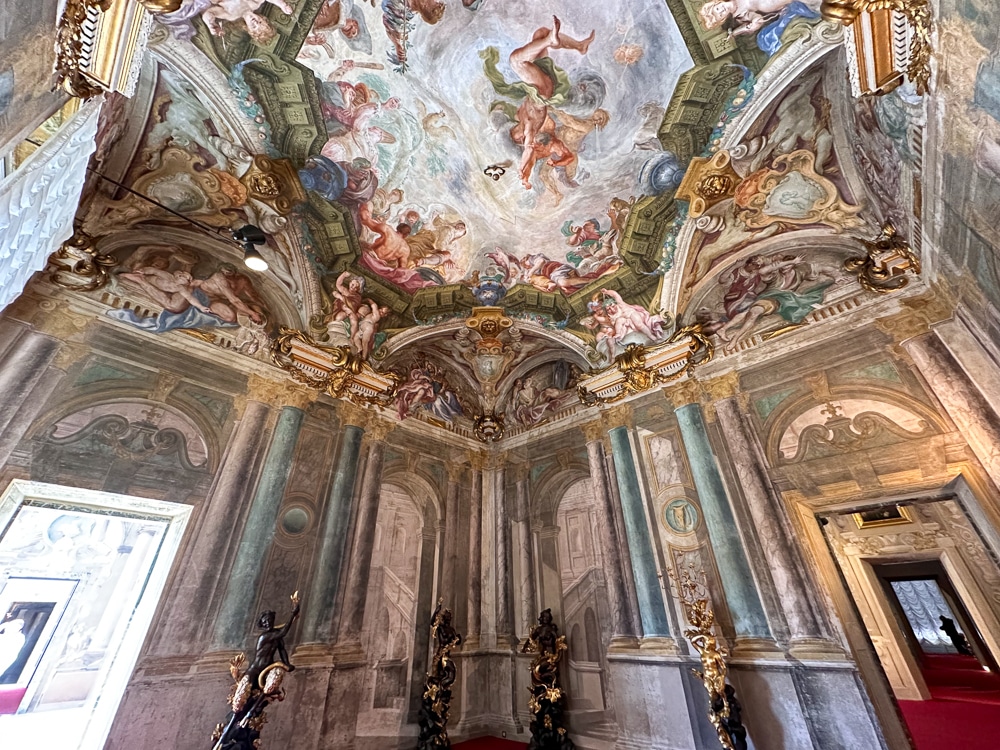
The centro storico of Genoa is a never-ending beauty. As you walk through the city, you’ll come across magnificent palaces showing the power and wealth of Genoa’s legacy. Built in the 16th and 17th centuries, these beautiful buildings belonged to Genoa’s nobility. The Republic of Genoa used these mansions as guesthouses for wealthy and influential people who were visiting the city.
These Palazzi were part of a special list formally called “Rolli degli Alloggiamenti Pubblici.” The Palazzi dei Rolli, or Palaces of the Lists, were categorized by how luxurious they were and used for guests who matched the appropriate status for each noble residence.
In 2006, UNESCO World Heritage status was given to a group of 42 of these prestigious Genovese buildings.
Via Garibaldi, also called Strada Nuova, was one of the “new streets” that wealthy Genovese families chose to build these mansions.
Specifically, 3 historic palaces are on this street, Palazzo Rosso, Palazzo Bianco, and Palazzo Doria Tursi. Today, these historic residences are museums and can be visited throughout the year. The rest of the Rolli Palaces (excluding the Palazzo Reale which is open year-round) are closed to the public except for the Rolli Days the city of Genoa plans every spring.
I’ve visited all 3 of the open Rolli Palaces and Palazzo Rosso, which was the residence of the Brignole-Sale family, was my favorite! The architecture, gilded trim, artwork, and frescoes were stunning! If you only have time to see 1 Rolli Palace, I recommend Palazzo Rosso.
Palazzo Bianco with its collection of European paintings from the 16th to 18th century and Palazzo Tursi with its fine arts, ceramics, tapestries, and musical instruments can also be visited with a combined ticket for all 3 Rolli Palaces.
ProTip: There’s a lot to see and understand about the history of these 3 Rolli Palaces. If you have the time and interest to see all of them, consider streamlining your visit with a guided tour. I don’t always recommend going with a guide but having been to the Rolli Palaces twice, I can confidently say it could make a big difference here as you try to figure out what to see across 3 large palaces.
Enjoy the Revitalized Porto Antico.
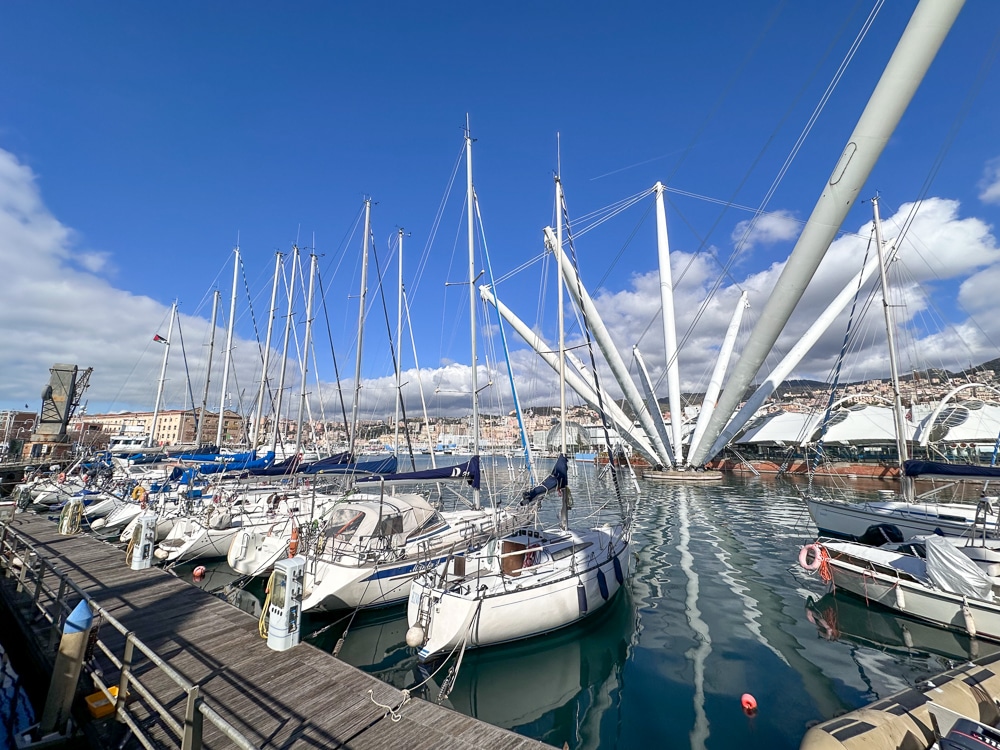
Besides the top sights of the Centro Storico, the port has numerous other Genoa attractions. Genoa’s history is rooted in the sea and, historically, was a powerful seafaring republic. This is still visible today in the Porto Antico (the ancient port), the former city center of commerce and now one of Genoa’s cultural centers.
The vibrant, palm-tree-lined Porto Antico has a lot to offer as you’ll see below. While you’re walking along the promenade, you can also shop and enjoy something to eat or drink. In the winter, you can ice skate on the port near the Bigo. During the summertime, you can swim at a portside outdoor pool.
From the port, cruise ships and tourist boats also set sail. If you have enough time, go and explore the surroundings of Genoa with day trips! (More on this below.) Places like Portofino, Camogli, and San Fruttuoso are just a few of the incredible spots you can find nearby Genoa.
See Tropical Life in the Biosfera (Biosphere).
In 1992, to mark the 500th anniversary of the “discovery” of America by Genoa’s native son, Christopher Columbus, the Porto Antico was renovated by Italian architect, Renzo Piano. Among the incredible attractions you can find in the port is the Biosphere.
This is a giant glass and steel bubble that floats on the water and has a tropical environment inside with more than 150 tropical plants and animals, like butterflies, iguanas, and birds.
Get Hoisted over the Port on the Bigo.
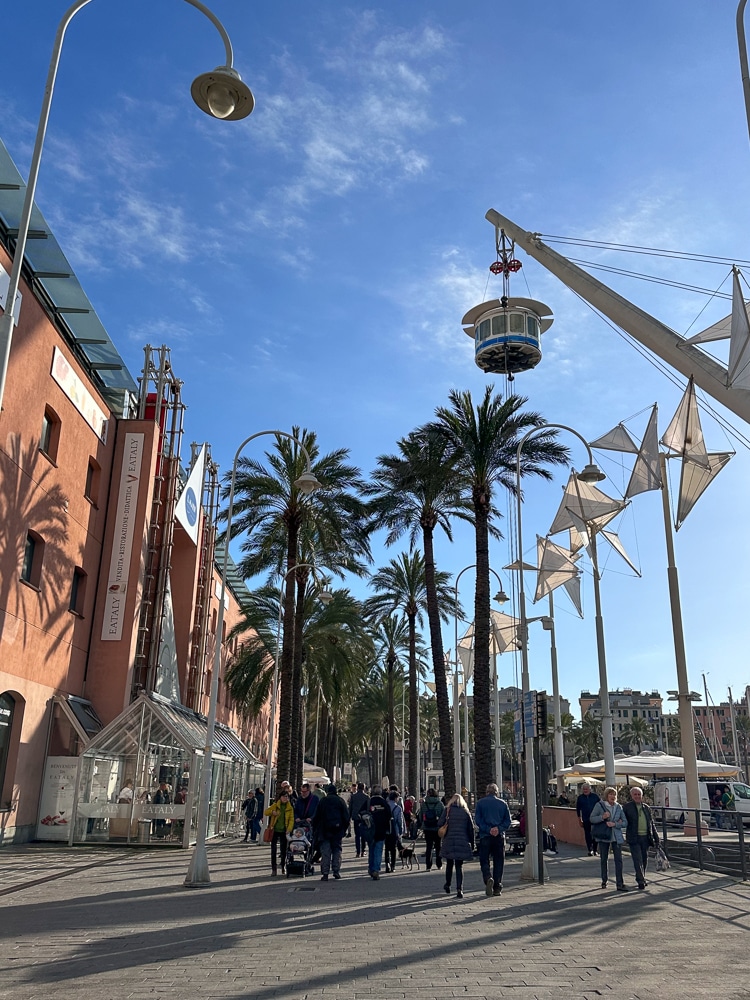
The Bigo is a panoramic elevator along the port near the Biosfera. Cleverly, it’s supposed to resemble an old shipping crane lifting cargo from a ship. The 10-minute ride takes you up 130 feet so that you can enjoy a 360-degree view of Genoa and the port.
See the Marine Life at the Acquario di Genova.
The Aquarium of Genoa is undoubtedly one of the most famous Genoa sights to see.
It’s the largest aquarium in Italy and home to 12,000 animals including fish, mammals like dolphins, birds, reptiles, and invertebrates like jellyfish. The aquarium wants you to feel as if you’re under the water seeing these creatures in action. You’ll walk past larger-than-life tanks that’ll give you a sense of how vast the oceans are.
The aquarium is quite popular, especially with families. If you go, be sure to get your tickets in advance or else you might find yourself standing in a long line for tickets.
Learn about Maritime History at the Galata Museo del Mare.
The Porto Antico also has the largest maritime museum in the Mediterranean. The Galata Museo del Mare is a 3-floor immersive experience. You can walk through a full-size ship galley and onto the deck of a historic ship replica. Along the way, artifacts like nautical charts and tools show how sailors navigated the seas. While signed objects belonging to Christopher Columbus, life rafts, and other memorabilia document hundreds of years of maritime history.
While you’re there, don’t miss the chance to go inside the Nazario Sauro submarine! It’s in the bay docked just outside and lets you experience firsthand the living conditions of sailors under the sea.
Before leaving the Galata Museo del Mare, don’t forget to go up to the rooftop terrace to enjoy views of the city and port.
Climb La Lanterna.
While Genoa’s Porto Antico looks very different today than it did 500+ years ago, its lighthouse, La Lanterna (“the lantern”), still stands tall over the port as it has since 1543 guiding ships in and out of the seaport.
The lighthouse itself is 249 feet tall and sits upon rock that elevates its height to almost 385 feet. Combined with its age, it’s one of the oldest and tallest lighthouses anywhere in the world.
When you visit the lighthouse today, you can climb the 170+ steps to the observation deck for views of the city and historic harbor. Afterward, you can watch some of the videos in the museum at the base of the lighthouse to learn more about the history of life in Genoa.
To get here, follow this half-mile path along the seafront. It’s a pretty walk with even prettier views from the lighthouse!
More Things to See and Do in Genoa
Outside of the Centro Storico and Porto Antica, there’s no shortage of experiences and special places in Genoa. I’ve listed some ideas below to help you plan a well-rounded trip to this gem of a city!
Eat as much Genovese Food as Your Body Will Allow!
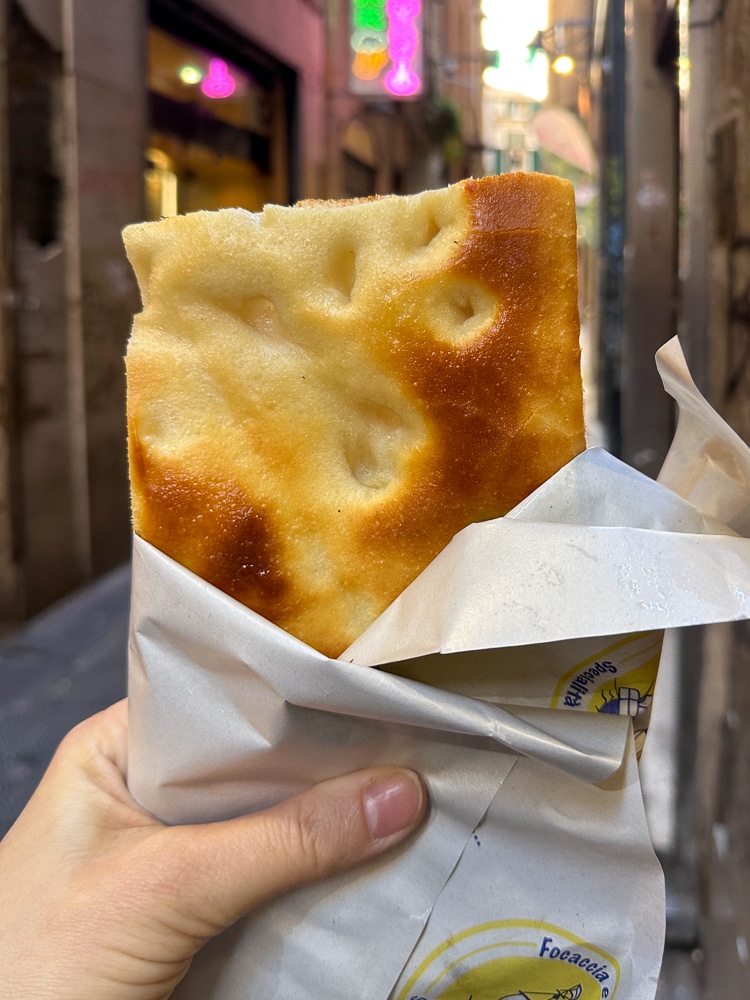
A trip to Genoa is not complete without tasting the delicious cuisine that the city has to offer!
There are many Genovese culinary specialties, and pesto is without a doubt the most famous one. This sauce has become the symbol of the city. Typically, pesto is prepared with pasta called trofie or mandilli, but it can also be found on bread like focaccia. Whichever you choose is fine, just don’t leave the city without a healthy serving of pesto.
Your Genoa food experience must also include eating a piece (or more) of focaccia. Crispy on the outside and soft on the inside, Genovese focaccia is well-oiled but not greasy. You’ll see plenty of varieties but the 2 main ways to eat focaccia are with extra virgin olive oil or with cheese. Besides these two classics, save room to taste other types like potatoes and rosemary, onions, vegetables, olives, and pesto. And if you really want to eat focaccia like a local, have it for breakfast with your cappuccino!
If you are staying in Genoa for more than a day and you are tired of eating traditional pesto, try the Pansotti con pesto alle noci. The Pansotti is a stuffed pasta similar to ravioli, stuffed with herbs and seasoned with a nut and cheese sauce usually made with walnuts and a pungent sheep’s cheese.
And lastly, it’s important to remember that all food is local in Italy. So it should come as no surprise, that Genoa’s seafood is another regional specialty. You won’t regret a single bite of Genoa’s “fritto misto al mare!”
Don’t Miss the Incredible Views from Spianata Castelletto.

Genoa is a city of layers. If you stay only by the port or the central Piazza de Ferrari, you’ve only scratched the surface. So much of the city sprawls upward and with height also comes incredible views.
While you’re in the area of Via Garibaldi and the Rolli Palaces, make the 3-minute walk to the elevator that whisks you up to Spianata Castelletto. (On Google Maps, search for “Ascensore Castelletto Levante, Piazza del Portello.”)
You’ll need a ticket which costs 2 Euros and needs to be validated in the orange box at the end of the long hallway just outside the elevator itself. Although, in my experience, it’s hit or miss if there’s someone there to check your ticket. So don’t be surprised if you don’t see anyone. Alternatively, if you have the 24-hour Genoa transportation ticket (which costs 10 Euros), you’ll have access to all the city’s elevators, funiculars, trains, buses, and the entire AMT transportation system.
Once at the top, you’ll have breathtaking views over the city, the port of Genoa, and the gorgeous Mediterranean Sea. You can also wander around a bit in the Castelleto neighborhood if you’d like to stroll or want a gelato. Even if you have just 1 day in Genoa, be sure to make the quick trip up to this panoramic viewpoint.
Spend Time along the Sea in Boccadasse.
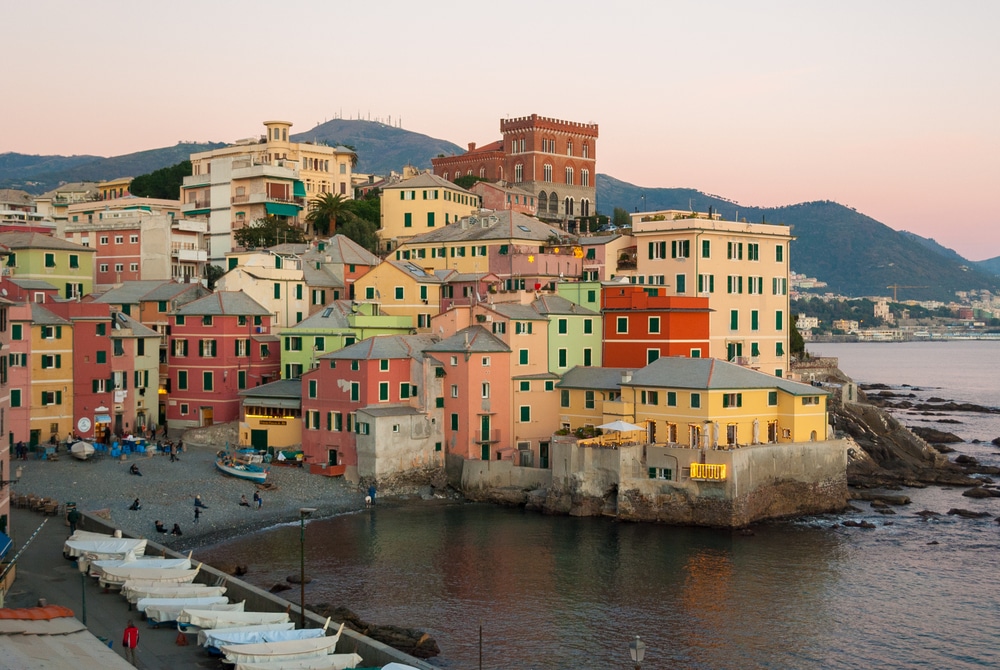
Tucked along the eastern fringe of Genoa is the historic fishing village of Boccadasse. With its colorful houses, small pebbly beach, and tiny bay, you’ll feel as if you’ve clicked your heels and landed in a miniature version of the Cinque Terre. All you need to complete the scene is a gelato or a snack of some Genovese street food like focaccia, farinata, or fried fish bites.
What’s different, though, is that unlike the much more cater-to-tourists vibe of the Cinque Terre, Boccadasse has remained unchanged even after hundreds of years with the fishermen who live there going about their day. It’s a spot that locals love and the savviest of visitors make their way to.
While there, you can explore the village’s small alleys and enjoy the seaside vibe along the promenade.
Boccadasse is a perfect place to spend a couple of hours away from the city streets of Genoa. I love to head there in the late afternoon to early evening as the sun dips to enjoy a spritz along the sea.
From Genoa, it’s easy to get to Boccadasse by bus, taxi, or on foot. By taxi, it’ll take about 15 minutes from the center of Genoa. From Piazza de Ferrari, bus #42 will get you to Boccadasse in about half an hour. Similarly, take the #31 bus from the Genoa Brignole area. You can also walk along the water via Corso Italia which will take just over an hour.
I recommend going by bus or taxi there, giving yourself enough time to explore and enjoy an aperitivo, before walking back along Corso Italia to watch the incredible sunset. If you’d like, stop for dinner in Boccadasse or at one of the restaurants along the Corso Italia promenade.
ProTip: Although Boccadasse has a small beach, I’d recommend a spot like Camogli, Santa Margherita Ligure, San Fruttuoso, or even Genoa Nervi if you’d like to spend a few hours beachside. The water in these places is much nicer for a swim and they’re easy to reach from Genoa by train or boat.
Explore the Castello d’Albertis Museo delle Culture del Mondo.
The Castle D’Albertis is located right outside the old town, on the hill of Montegalletto, where once stood a wall to protect the city. Today, it houses an interesting and somewhat quirky museum,
The neo-Gothic castle sits in a panoramic position over the city of Genoa and was originally the house of Captain Enrico Alberto D’Albertis. D’Albertis was a sea captain who decided to use his own home to display the memorabilia that he collected during his voyages in Africa, the Americas, and Oceania. Upon his death, he gave the castle and the museum to the city where it has grown into highlighting the perspectives of the people D’Albertis encountered along his travels.
While the museum is intriguing, the castle, gardens, and beautiful views from the castle overlooking the city are worth the trip up on the Montegalletto Lift (Acensore Montegalletto-Balbi) all by themselves!
Take an Italian Riviera Day Trip from Genoa.
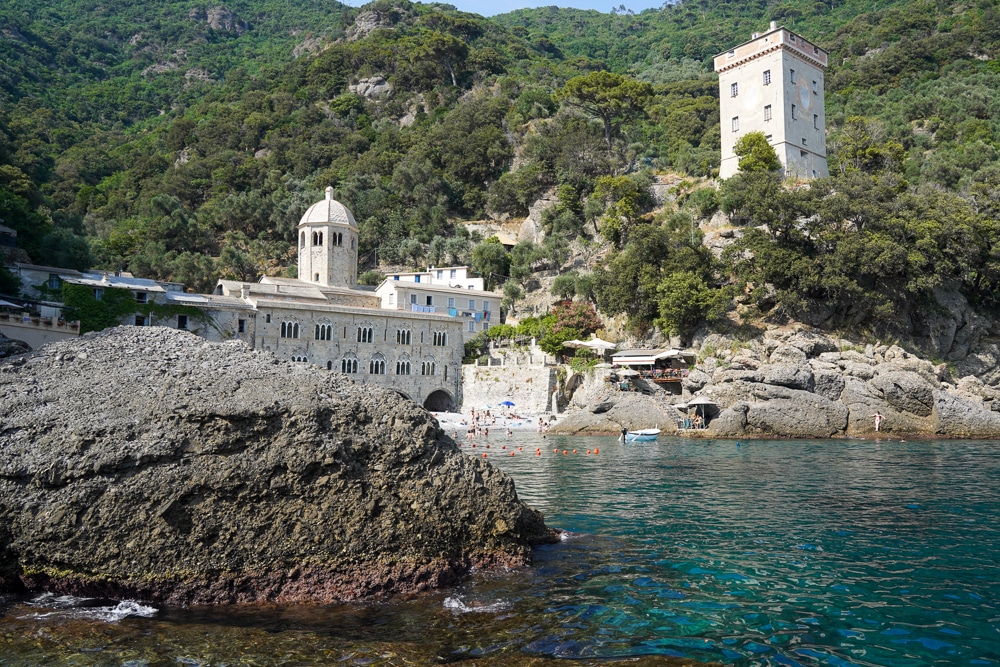
Genoa sits perfectly along the Mediterranean Sea as the gateway to the gorgeous Italian Riviera. If you’re spending a few days in the city, you can’t miss seeing the Ligurian coastline.
One of the easiest ways to do this is to take a ferry from Genoa to Portofino. You can stop at places like Camogli and San Fruttuoso, both Italian Riviera gems, along the way for a fantastic day.
I’ve done this trip multiple times and what I love about it is that you can think of the boat as a hop-on-hop-off type of experience. Once you get to one of the stops, you’re free to spend your time however you’d like. You can also choose to stay for a while in a place or even skip one of the stops altogether.
If you’d like, you can read my full review of this fantastic Genoa day trip.
Planning Your Trip to Genoa
This underrated northern Italian city has so much to offer! And chances are that you’re on a tight schedule with limited time to explore.
So if your Genoa itinerary is short, you’ll want to focus on the main sights in the Centro Storico and Porto Antico. Don’t miss the chance to see the Royal Palace and at least one of the Rolli Palaces. I would recommend Palazzo Rosso. Make a point of seeing the Cathedral of San Lorenzo, Piazza de Ferrari, Via XX Settembre, and of course, walking along Genoa’s revitalized port. Then finish the day by taking in the beautiful city views from Spianata Castelletto.
Use the Genoa tips below to plan the rest of your trip logistics.
Where to Stay in Genoa
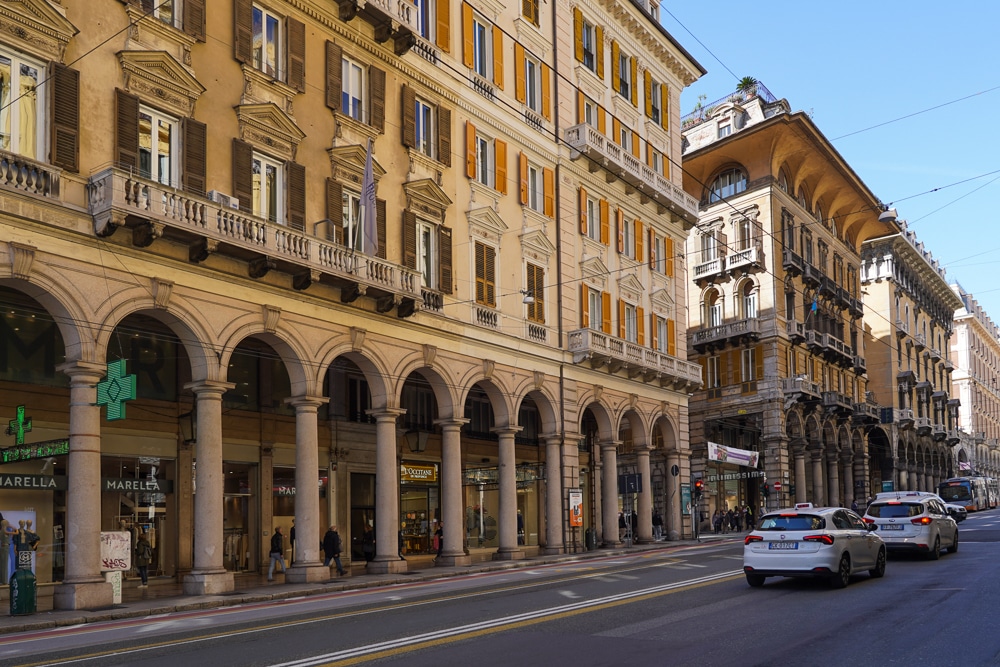
After lots of exploring – and lots of eating – finding a place to rest is more than necessary. Most of Genoa’s things to see and do are located in the Centro Storico and the Porto Antico, so these are also the best areas of the city to stay.
Hotel Palazzo Grillo is a historical palace in the heart of Genoa’s old town just a 5-minute walk to Piazza de Ferrari. It was built in 1545 by order of the noble Domenico Grillo, and thanks to the quality of the decorations and architecture of the building, it was inserted into the lists of the Rolli. The palace was renovated in 2011 and converted into a hotel by preserving the original architectural ornaments.
Hotel Bristol Palace is also situated in the Centro Storico on Via XX Settembre. This renovated 5-star hotel has 133 elegant rooms, a gourmet restaurant, and two bars. This glamourous hotel is right in the heart of the city near shops and restaurants and just steps from many of the city’s top sights.
Best Time to Visit Genoa
Genoa is a city that can be visited at any time of the year. The spring months and the period September-October are the mildest months, with the climate at its best to walk around. I’ve spent time in Genoa during every season and highly recommend this time of year if you have the choice.
In winter, Genoa rarely drops below freezing or sees snow. The days can come with some rain which makes it feel damp and colder than the actual temperature. Yet, if you don’t mind the brisk air, many days can also be quite pleasant for sightseeing.
In July and August, the weather is quite hot, and the Italian Riviera is usually packed with tourists. Still, Genoa’s location on the water makes it somewhat more comfortable than landlocked cities in Italy.
Special events happen in Genoa throughout the year.
In May, Genoa is animated by the Rolli Days, the days when the city opens many of the Rolli Palaces for special guided tours and events. If you’re visiting the city around this time, check for the specific dates and, if you’d like, try to get tickets in advance to see some of these gorgeous noble homes.
In September, Genoa hosts the Salone Nautico, the International Boat Show which draws in 100k+ boat and yachting enthusiasts to the city.
What Would You Like to Do in Genoa?
Genoa gets overlooked by many visitors to Italy in favor of more popular northern Italian cities, like Venice, Milan, Bologna, and Turin. This is such a shame because the city’s energy, historical buildings, cultural sights, and position along the sea are a compelling trio to include Genoa in your northern Italy itinerary.
I hope this guide has convinced you to spend some time in Genoa. Besides being pleasantly surprised by what the city has to offer, it might even become the surprise hit of your Italy trip!
So, what are your questions about what to do in Genoa?
Like this post? Please share it on social media using the share buttons!
