
A few years ago, my husband and I, together with my sister and her husband, bought a house in the Piemonte region of Italy. And we’ve since spent a couple of years renovating our beautiful countryside house from top to bottom.
Along the way, we’ve learned A LOT, starting with the very beginning and the process of buying property in Italy as a foreigner. (We’re U.S. citizens.) And whenever anyone asks us, in real life or online, the number one question is how to get started/how do you buy property in Italy.
So, I’m finally putting pen to paper (fingers to keyboard actually) to share what we’ve learned and talk about our experiences.
Please note: I am not a legal expert or a real estate agent. I’m simply someone who has gone through the process and hope that my experiences can make your home-buying process in Italy as smooth as possible.
Why We Bought a House in Italy’s Piemonte Region

When we started our Italy house search, we were looking in southern Italy. We focused on places in Puglia and Campania because our Italian ancestors were from these areas.
But we took a step back to consider what we were actually looking for instead of getting swayed by beautiful photos of villages and views selling the Italian lifestyle.
Ultimately, we made a list of the things we were looking for in a potential location.
- A place with access to the mountains and sea (We have Liguria and the Italian Riviera to our south and the Alps and lakes to our north.)
- Close to great cities (An hour-ish or less to Milan, Torino, and Genoa)
- An airport with direct flights to the U.S. (Important during renovations and also moving forward. There are daily direct flights to/from Milan and NYC.)
- Beautiful countryside with great food and wine (lots of places have this, but we loved the rolling vineyard hills in Piemonte that are famous for Barolo and Barbera wines)
- Access to other places in Europe, like France and Switzerland (Easy drives in just a couple of hours)
- Great connectivity to many places in Italy (It’s not hard to get to the lakes, and even places like Florence and Venice are only 4 hours away.)
- A house with different parts to give everyone space and privacy while still having great communal areas (Important when buying with family)
- Affordability (We needed to find something to match our budget.)
With all of these things in mind and doing hours of research, we landed on the region of Piemonte in northern Italy.
Specifically, the area of Monferrato, which is often grouped with the Langhe and Roero areas. This is where grapes for Barolo, Barbaresco, and Barbera are grown, along with countless other grape varieties, and it has been named a UNESCO World Heritage Site.
The Langhe is the most famous, and house prices reflect that. Monferrato is lesser-known but comes with the same beautiful landscapes and is better positioned with proximity to the main international airport in Milan.
The houses in Monferrato typically are also more affordable than the Langhe but often need renovations, which we weren’t opposed to if it meant a lower pricepoint to start.
Head here for our full step-by-step story of buying and renovating a house in Italy.
Can Foreigners Buy a House in Italy?
So, can Americans buy property in Italy? We’re proof that yes, it’s allowed.
The U.S. and Italy have reciprocal agreements when it comes to letting their citizens buy a house in the other’s country.
Not all countries have this reciprocal agreement, though. In some cases, when there isn’t a straightforward reciprocal agreement about buying property, Italy may have specific exceptions for citizens of these countries.
For example, Canadians may be able to buy a home in Italy in towns and villages with fewer than 10,000 residents. But I am not an expert in these individual country rules, so it’s important to check.
What Do Foreigners Need to Buy Property in Italy?
You’ll need an Italian tax ID known as a “Codice Fiscale.” It’s not difficult to get, but it’s necessary. If you find a house listed by a real estate agent, sometimes the agent can help you get your Codice Fiscale. Otherwise, you can go through your local Italian Consulate if you have one within reach or get one in person in Italy.
Personally, I used a lawyer to get my codice fiscale because it was just after things began opening after the pandemic, and it was still difficult to get appointments. Not to mention how backed up Italian consulates were. I avoided the headache and had my codice fiscale in just a few days.
Once you have this tax ID, the only other thing you’ll legally need to buy a house in Italy is a notary (notaio in Italian) to conduct the closing and legally file all the paperwork. A lawyer isn’t required for buying a house in Italy and we didn’t use one to help us with our closing.
Schengen Area Rules and Visas
It’s important to understand that buying a home in Italy as a non-EU citizen doesn’t grant you automatic residency.
As an American, you’re still bound by the 90-days-in-every-180-day-rolling-period rule for visitors. So, without a visa, declaring residency, or having dual citizenship, you aren’t able to stay at your house for more than 90 consecutive days in any 180-day period.
You can apply for visas like the Digital Nomad Visa or the Elective Residency Visa to stay longer. Or you could pursue residency and a Permesso di Soggiorno to live in Italy legally. Otherwise, you could check your eligibility for Italian citizenship depending on your ancestry.
How We Found Our House in Piemonte
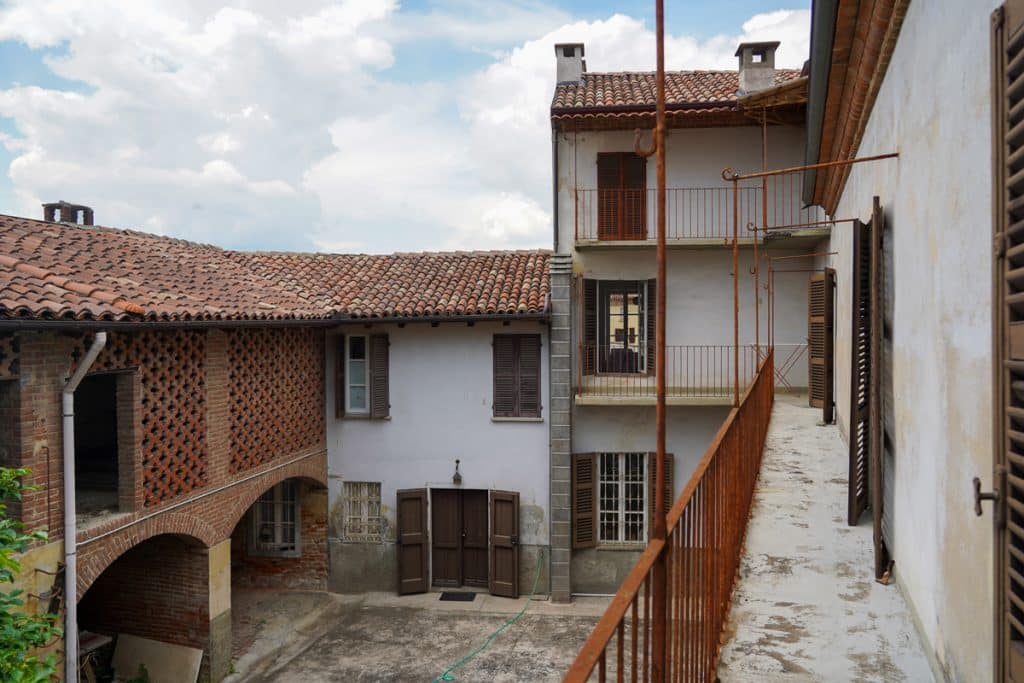
We used three different websites: Idealista.it, Immobiliare.it, and Casa.it to search for houses and research villages and towns. Using Google Maps street view and an eventual trip to the Monferrato area, we narrowed our search to a specific set of villages.
Our house was listed on all of these websites, but we first saw it on Idealista. It was one of the few properties we saved that was for sale by owner.
To be honest, I was a little hesitant about this because it felt “safer” to look at houses listed by a real estate agency, so I held off on reaching out to the sellers for a while.
But eventually I messaged the sellers on WhatsApp and we started talking. They even did video call tours of the house before I eventually saw it in person.
Before putting in an offer on the house officially, we did a few very important things to confirm the structural integrity of the house and ensure it had all of its paperwork legally in order. You can read more about the things you should do before buying a property in Italy here.
Real Estate Agents and House Listings in Italy
There’s a lot to say about all of this, but it’s important to understand a few basics.
First, Italian real estate agents work for the seller and only have access to the properties where they are the agents. Italy has no MLS like we do in the U.S., so one realtor can’t take you to see a house listed by another agent.
This can make the process difficult because instead of dealing with one real estate agent, you’ll be speaking with numerous agents, depending on how many houses you want to see.
What I found the most baffling during our Italy house search, though, was the number of real estate agents who don’t respond to emails or messages.
Don’t be surprised if there’s a house you really like, but you aren’t able to reach anyone to talk about your interest. This happened to me, and I just learned to move on and keep searching.
The websites I mentioned above are the best tools to look for Italian homes, given that there’s no MLS. You can search in specific areas or regions and use the filters to find what you’re looking for.
The tricky part is actually seeing what the house looks like, though. I have no idea why, but many property listings in Italy have terrible photos, photos of random things, and sometimes no photos at all. So it’s hard to really see what a place looks like without a video call or an in-person visit.
I absolutely recommend seeing the property before buying it if you can. If not, ask the sellers or real estate agent to do a video tour or hire someone to do it on your behalf.
Lastly, keep in mind, a lot of properties in Italy, especially in the countryside, often need work or, at the very least, significant updating. If the photos online were useless, it could be a surprise when you actually see the home on a video or in person.
What to Expect When Finalizing a House Purchase in Italy
After seeing our house a few times on a trip to Italy, we were prepared to make an offer and go through the necessary steps to finalize the purchase. What we didn’t expect was another American to swoop in and try to buy it before us!
And before you get suspicious that this was a tactic by the sellers, the story is totally legitimate, and ironically, we are all now very good friends. (The other American bought another house in the same village.)
Hopefully, you don’t have this unexpected drama, and things proceed as they should.
The Compromesso
Once your offer is accepted, a notary draws up the preliminary contract known as the “Compromesso.”
It’s at this point that you agree to all the terms including sale price, what’s included (i.e. furniture), and a closing date. You’ll also pay a 10-20% deposit. We used Wise to transfer dollars to Euros because it has the best exchange rates and the lowest fees compared to regular banks in the U.S.
From this point on, the sale is locked in, so to speak, because if you were to back out after signing the compromesso, you’d lose your deposit. If the sellers back out now, they’re legally responsible for paying you double the deposit.
The Rogito
After this, you’ll meet on the agreed-upon date for the closing at the notaio’s office for what’s called the “Rogito.”
Usually, the remaining balance owed for the house is paid to the notaio’s account within a few days before the closing day. We didn’t go for a mortgage in Italy because we split the cost of our house in Italy with family, making it much more reasonable for us to pay cash.
It’s not impossible for foreign buyers to get a mortgage in Italy, but in many cases, it’s better if you have an established relationship with an Italian bank beforehand. Even still, you’d likely need to put down about 50% of the purchase price.
Personally, if I was in the position of needing financing to buy a house in Italy, I’d look at assets in the U.S. to see if I could use any equity or investments to pull from instead of dealing with the bureaucracy in Italy. It’ll almost always be easier.
Closing Costs and Getting the Keys

It’s a surreal feeling when you’re handed a set of keys after buying a home in Italy. In our case, there were at least 30 keys for all the random doors, gates, and barn spaces, some that were huge skeleton keys straight out of a medieval thriller! (Check out our full renovation journey to see what our house looked like when we bought it and as we went through the process of renovating.)
But before you get to this exhilarating moment, the notaio will read the deed and confirm that all money for the house, the closing costs, and the notaio’s fee have been paid.
If you intend to live full-time as a resident in your Italy house (and assuming you have no other property in Italy), you’ll pay a 2% registry tax on the cadastral value of the home.
If this isn’t your first house in Italy or you’re buying the house as a foreigner with no residency or plans to become a resident, you’ll pay a 9% registry tax on the cadastral value of the property.
Additionally, the notaio’s fee is typically 1-2% of the property’s value.
Depending on your situation, you could have additional fees. Our house was for sale by owner, so we didn’t need to pay a percentage to a real estate agent.
Also, we didn’t need to hire a translator because our notaio and the seller both spoke English. We’d also reviewed and translated the closing documents ourselves prior to the official closing with my husband’s parents who speak Italian.
If you choose to hire a lawyer for the closing, these fees are on top of everything else. But, Italy doesn’t require a lawyer at house closings because a notaio/notary in Italy specializes in real estate law. So, it’s only something to add if you feel the need to have one with you.
ProTip: We were lucky that our sellers were very hands-on and willing to help us. But if the closing is the last time you’ll see the sellers of your house, be sure to get all the info about the utilities so you can switch the accounts into your name. Friends of ours who bought their house in Italy also got help with this from their real estate agent.
Congratulations on Buying a Home in Italy

If getting keys is surreal, then stepping foot into the house for the first time as the owner is both extraordinary and humbling. I hope this guide gives you a sense of the process so you can begin your own Italian house journey.
If you have questions about buying a house in Italy, drop it in the comments below and I’ll reply.
For our full Italy house story and renovation journey, see Renovating a House in Italy: Our Step-by-Step Story from Purchase to Final Reveal.