
With one day in Turin, you’ll need a plan to make the most of your visit to this beautiful northern Italian city.
I spend several months each year living in the hills of Piemonte just outside of Turin and I just can’t resist the city’s magnetic pull. I’ve spent a lot of time here in every season crisscrossing the city to see the top sights, uncover hidden gems, and sometimes, just stroll under the city’s porticoed sidewalks.
Using all of these first-hand experiences, I’ve put together this 1 day in Turin itinerary. Plus, I’m sharing all my local tips to make sure you end up loving Turin as much as I do. Andiamo!
How to Spend One Day in Turin
Turin, or Torino in Italian, is the capital city of the Piedmont region of northern Italy and actually was the first capital of Italy when the country unified in 1861. Today, this former royal city is a cultural and foodie hotspot known for its many museums, beautiful baroque architecture, UNESCO World Heritage Sites, and, most importantly, chocolate, coffee, and rich Piemontese cuisine.
Despite all of this, though, Turin still gets overlooked by a lot of travelers to Italy. You may see lines at a few of the more popular things to do in Turin, but as you walk around, the city feels small, local, and authentically Italian. Plus, it’s easy to navigate which is a real bonus when you only have a day in Turin.
As with any city anywhere, it’s impossible to see it all in a day. And if you can, I highly recommend staying at least 2 days in Turin to really appreciate what an absolute gem the city is. But I get it. Italy is full of amazing places to see and your time is precious.
Good to Know: Turin is the city’s name in English. Torino is the city’s name in Italian. For this article, I’ve used both interchangeably because they refer to the same city.
Map of Your One Day in Turin
Using the Turin map below, you’ll see exactly what I recommend and the route to take throughout the day. I’ve personally created and tested this route to maximize the day and limit backtracking.
How to Use this Map:
Click the star on the left to save the map to your “saved maps” in Google Maps so that you can view it when you open Google Maps on your phone.
Click the box with the arrow on the left to see a full list of points shown on this Turin map. The map is broken into morning and afternoon segments. If you’d like to see just one part, uncheck the other part so it disappears from the map. The box frame on the right will expand the map to full screen in a new tab.
What to Do in Turin for a Day

To make the most of your time, plan to use the full day. Plus, you’ll want to keep in mind a couple of very important Turin travel tips.
First, many museums, cultural sites, including the Royal Palace, and even shops and restaurants are closed on Mondays. There are exceptions to this rule. Most notably, the Mole Antonelliana is open on Mondays but closed on Tuesdays. Palazzo Madama is also open on Mondays and closed on Tuesdays.
So, to truly get a sense of the city, I highly recommend planning your one day in Turin from Wednesday to Sunday. By doing so, you won’t miss out on seeing something you really want to see.
Another thing to understand, even though you’re in Italy’s 4th largest city, many restaurants in Turin follow typical Italian hours. They aren’t open all day. Instead, restaurants open for a couple of hours at lunch (typically around noon until about 2 p.m. or 2:30 p.m.) and again for dinner (typically no earlier than 7 p.m. until about 10 or 10:30 p.m.) In between meals, they’re closed.
Again, you’ll find exceptions and these mainly cater to tourists. Some places may stay open to serve coffee and drinks while still closing the kitchen in between meals.
This means, your day in Turin needs to be planned around these hours unless you decide to skip lunch. But trust me, you’ll be missing out on the city and the region’s delicious cuisine! So, as you look at the step-by-step itinerary below, I’ve filled the morning and the afternoon around Italy’s typical lunch break.
Stop 1: Baratti & Milano
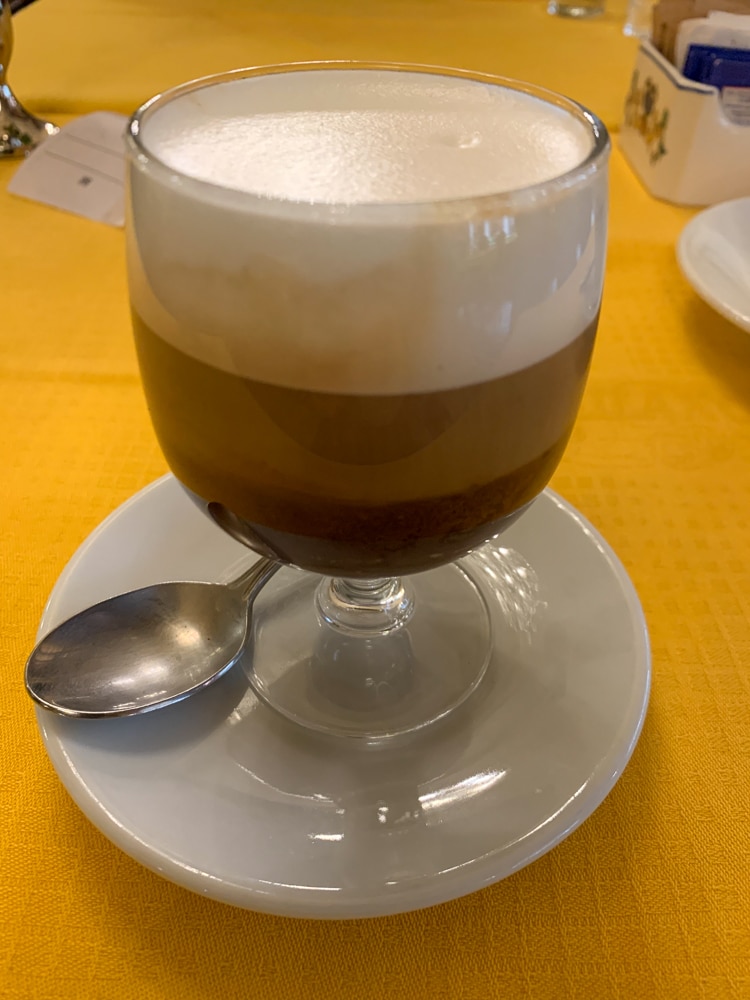
Start your day with Turin’s signature drink, a Bicerin, and a pastry at one of Torino’s most historic cafes. It’s an easy way to experience 2 of Torino’s musts while the day is still fresh!
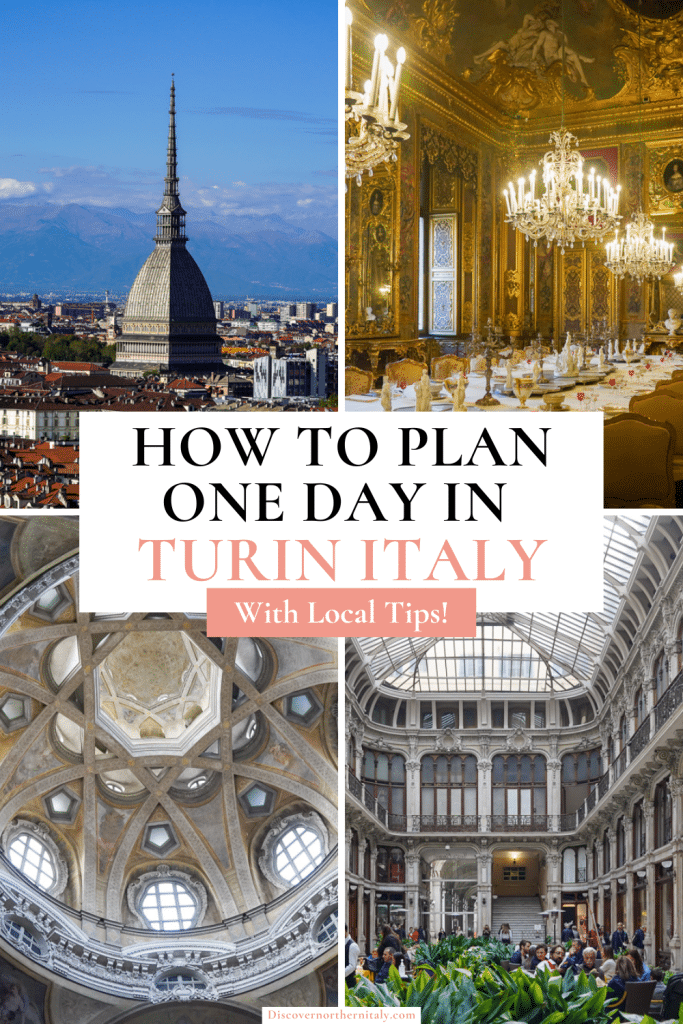
Baratti & Milano opened in 1875 and is the epitome of elegance and sophistication. The glass chandeliers, wood paneling, flowing window treatments, and glass mirrors will put you in a royal state of mind even before you get to the Royal Palace.
And, although Caffe Mulassano is another excellent historic cafe option nearby, I recommend going to Baratti & Milano because they open at 9 a.m., a half-hour earlier than Caffe Mulassano. It may seem minor but the extra half hour will certainly come in handy today!
Order the classic drink of Turin, a bicerin, with its 3 layers of espresso, chocolate, and cream. Be sure to sip and not stir because the flavors are meant to mix in your mouth. Pair it with a pastry of your choice for a classic Torinese breakfast.
Before you move on, take a moment to admire the Galleria Subalpina. It’s just outside of the cafe, which also has seating in the center of the Galleria. The glass atrium with its greenery and shops is one of the prettiest spaces in Torino!
Stop 2: Piazza Castello

Now that you’ve been properly energized, walk to Piazza Castello. It’s just a 4-minute walk from Barrati and Milano.
The square is the heart of all things Savoy, Italy’s former Royal family. The wide-open rectangular square is home to the Royal Palace and its complex of museums, as well as to the royal residence Palazzo Madama, and the Royal Church of San Lorenzo. Both the Royal Palace and Palazzo Madama are part of the UNESCO World Heritage Site that groups 14 Savoy residences in total.
The buildings in Piazza Castello date back to the 16th-18th centuries. If you follow this itinerary as is, you won’t be going inside Palazzo Madama but you can take a moment to appreciate its unique structure. On one side, it has a baroque facade and, on the other side, it has a medieval facade that originally comes from former Roman defensive towers and a wall that goes back to the city’s roots.
On the opposite side of the square from Palazzo Madama, the streets lead to Turin’s Quadrilatero neighborhood, the oldest part of the city. You’ll also notice the entrance to the Royal Church of San Lorenzo.
Looking toward the back of the square, past the wrought-iron gates, you can take in the refined facade of Turin’s Royal Palace. There’s also a passageway (on the left as you’re facing the palace) that takes you to the Duomo di Torino, the cathedral where the Holy Shroud of Turin is kept.
Stop 3: Cathedral of San Lorenzo

Before heading to the Royal Palace, stop to see the inside of the Royal Church of San Lorenzo. The entrance is on the left side of Piazza Castello before the Royal Palace’s wrought-iron gates. I recommend taking a peek inside now because the church closes at lunch and doesn’t reopen until later.
This baroque royal church was finished in the late 1600s in honor of a Savoy battle victory that took place more than 100 years prior. The first thing you’ll probably notice about this church is that, aside from the octagonal dome at the top, its facade doesn’t look like a church at all. You’d never guess the ornate interior that awaits!
Inside, in particular, spend a few moments focusing on the dome. Designed by Guarino Guarini, a baroque architect from the Piedmont region, the geometric pattern of the dome’s windows creates what looks like faces (thought to be the devil) frighteningly staring down at you.
Stop 4: Palazzo Reale di Torino
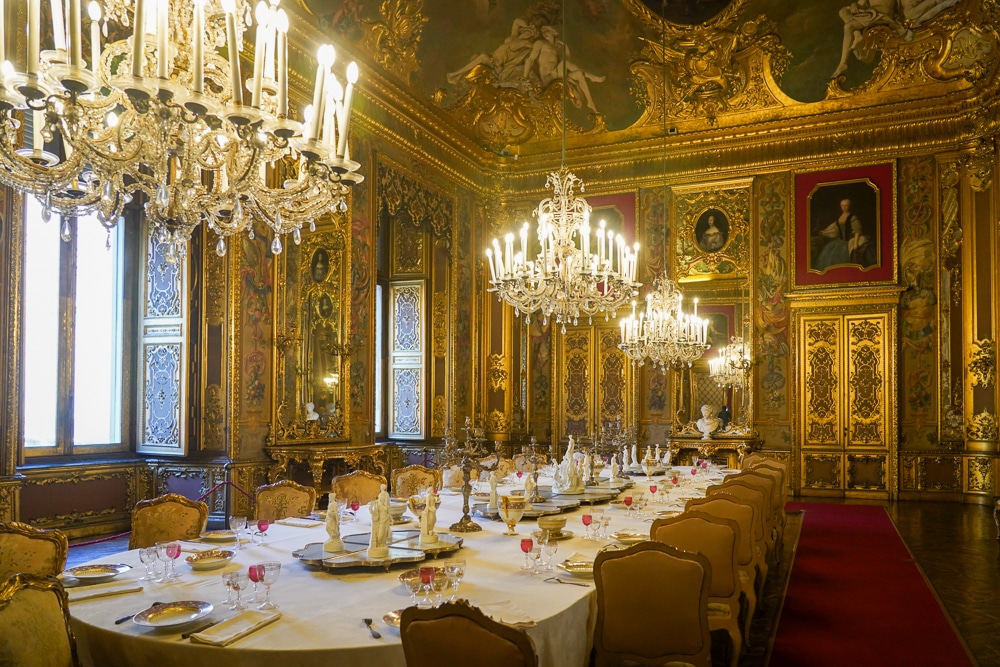
Exit the church and head toward the 16th-century Palazzo Reale at the back of Piazza Castello. To avoid wasting any time waiting in line, be sure to get your tickets online ahead of time. The Royal Palace of Turin is one of the most popular sights to see in the city and can be crowded.
The Royal Palace and its collection of Royal spaces take several hours to fully explore. I recommend focusing on the Royal Palace itself, the Royal Armoury, and the Chapel of the Holy Shroud. This should take roughly 90 minutes to complete depending on how many photos you take and the time it takes to listen to the (optional) audioguide or read the informational panels which are available in English.
For reference, I’ve visited the Royal Palace many times and have stayed for nearly 2 hours, solely focusing on these areas of the complex. However, I take a lot of photos.
Right from the start, the grand staircase in this House of Savoy gives the impression of wealth and magnificence. Think ornately carved marble, sculptures, and frescoed walls and ceilings. The palace staterooms are just as beautifully adorned with lavish tapestries, painted ceilings, golden trim, and sparkling chandeliers.
As you loop through the staterooms, you can access the spectacular Royal Armoury. Be sure not to miss it. The frescoed ceiling in the Royal Armoury is easily the most gorgeous in the entire palace. Heading back the way you came, you’ll finish the Royal Palace tour.
When you’re back in the room where you started, visit the Chapel of the Holy Shroud before leaving. This was the original chapel built to keep the famed religious relic safe. It stayed here for nearly 300 years before it was eventually moved to the Duomo di Torino in 1993. While you’re there, look up the chapel’s dome. You might recognize the geometric pattern style, also designed by Guarino Guarini.
If you’d like, take a stroll out into the Royal Gardens before you leave. Depending on how leafy the trees are when you visit, you might be able to spy the dome and spire of the Mole Antonelliana.
Stop 5: Duomo di Torino
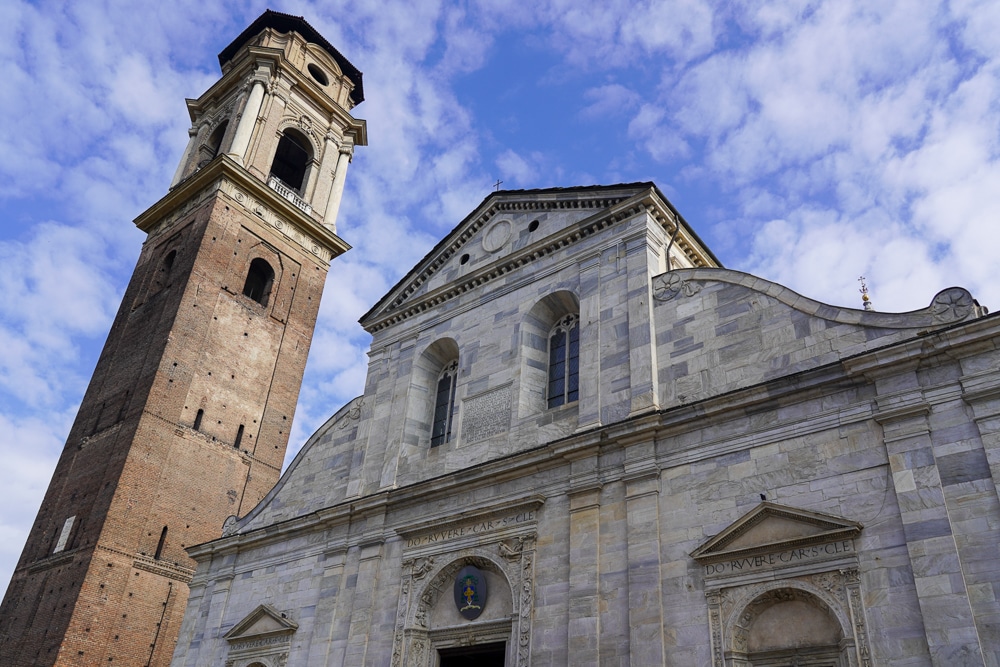
As you exit the archway leading in and out of the Royal Palace, head to the right and through the passageway. The Duomo di Torino, also known as the Turin Cathedral and the Cathedral of San Giovanni in honor of St. John the Baptist, is where the Holy Shroud of Turin is kept. Otherwise, the 15th-century Cathedral has a comparatively plain exterior and interior.
The Holy Shroud is a piece of linen believed to be the cloth used to wrap the body of Jesus Christ after he was crucified. It has a faint image of a man thought to be Jesus’ likeness imprinted on the cloth. For Catholics, this is one of the most important religious relics of the faith.
For its preservation, the real Holy Shroud isn’t on display. But at the back left corner of the Cathedral, there’s a replica on display in a glass-enclosed shrine for you to see and pray near.
If you’re not interested in this artifact from either a religious or historical standpoint, feel free to skip this stop.
ProTip: The 15th-century Bell Tower next to the Duomo can be climbed. If you’re pacing well, you might consider a quick trip to the top. The view is very pretty but not the panoramic views you’d get elsewhere in the city.
Stop 6: Porta Palatina
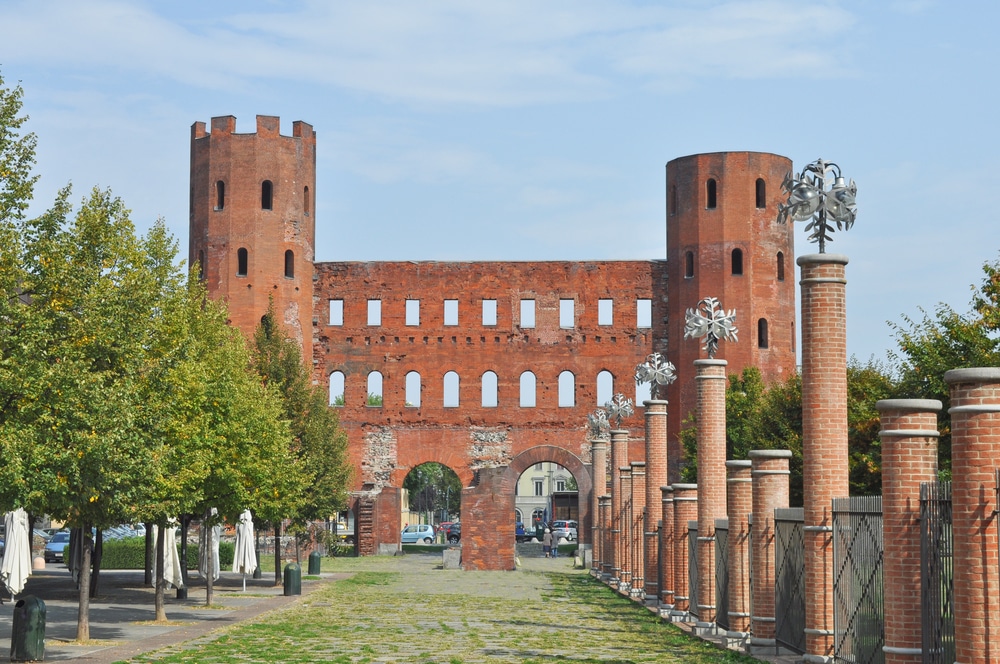
Depending on how you’re timing and keeping in mind the Italian lunch break, make the 4-minute walk from the Cathedral to Porta Palatina.
This 1st-century Roman gate and the surrounding Roman ruins in the Archaeological Park are the most visible pieces of the ancient Roman settlement that was once here. The area is free and open to the public to visit and doesn’t take long to visit.
The gate is the most impressive ruin here and, in fact, it’s one of the best surviving Roman gates anywhere in the world. The towers and defensive wall in between would have been on the northern side of the ancient city and an important gateway for people who lived here, as well as for anyone traveling to points further off in the Roman Empire via the Alps.
After having spent the morning immersed in all things baroque and Savoy, Porta Palatina gives you a glimpse of another aspect of Turin’s history.
Stop 7: L’ora di Pranzo…Lunch Time!
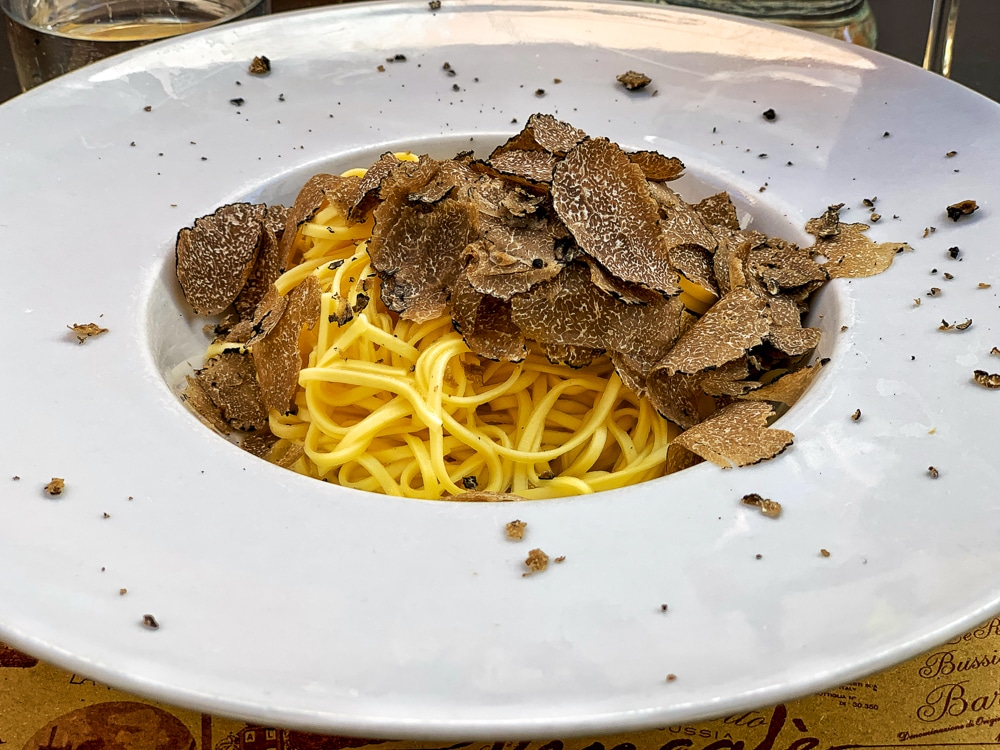
My suggestion is to have lunch somewhere back in the vicinity of Barrati & Milano so that you’re positioned for the afternoon. One place I love to go when I’m in this part of Torino is called Taberna Libraria located on Via (Gianbattista) Bogino just off the main thoroughfare of Via Po. The restaurant has delicious local specialties and offers an authentic Turin lunch experience at reasonable prices.
On the menu, you’ll find plenty of Piemontese classics like Vitello Tonnato (thinly sliced veal topped with a tuna sauce), Agnolotti sugo d’arrosto (small filled pasta served with a clear meat sauce), and Tajarin (locally made egg noodles) with truffles, as well as cuts of beef prepared in the style of the region.
During the week, especially, it can be busy with locals so plan to arrive right as they open for lunch or use the email on their website to make a reservation. By doing so, you avoid the stress and inevitable time wasted trying to find something last minute and possibly falling into a place that’s more of a tourist trap.
ProTip: Taberna Libraria is closed on Sundays. If you visit then or the restaurant is full, try classic Piemontese food at Le Vitel Etonne just a block away. Not to mention, it’s one of the rare restaurants with an open kitchen for most of the day in case you spend more time at the Royal Palace complex of sites.
Stop 8: Mole Antonelliana
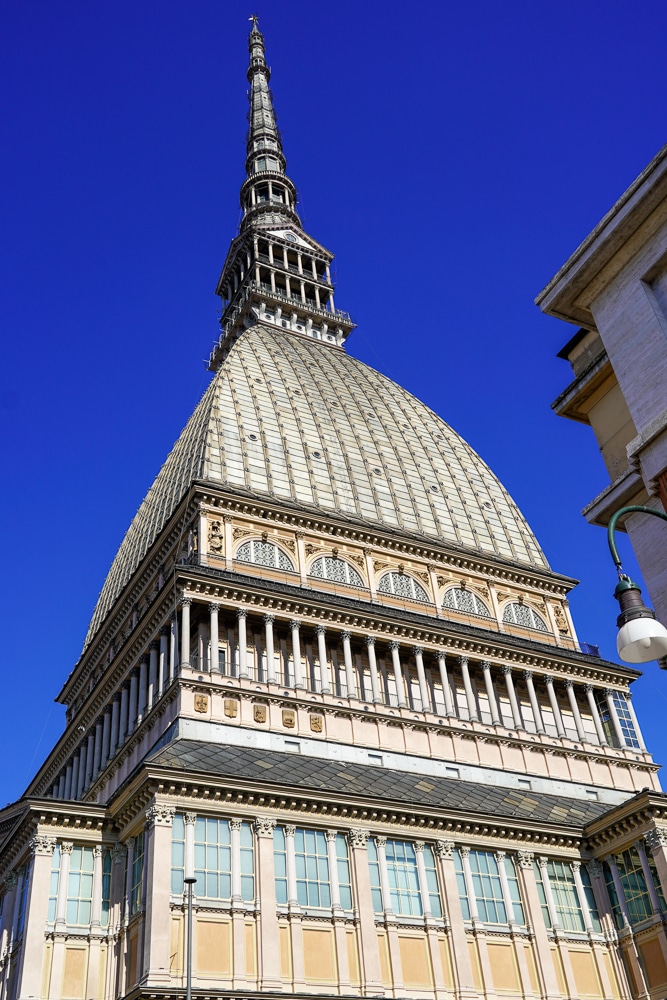
With half of your one day in Turin passed, you’ve seen and tasted some of the best of Torino! And if you had lunch at one of the places I suggested above, then, you’re perfectly positioned for your next stop, the iconic Mole Antonelliana. The building’s square-like dome and spire are the symbols of the Turin skyline.
Inside, there are 2 main attractions, the National Cinema Museum (Museo Nazionale del Cinema) and the Panoramic Lift for sweeping city and mountain views from the terrace nearly 280 feet up. You can choose to do both or just the one that interests you the most.
I highly recommend taking the Panoramic Lift up to the observation deck at the top of the building. On clear days, especially, you can see all of Turin and the Alps circling the city’s edge. Without a doubt, it’s one of the best overhead views of Torino.
The National Cinema Museum is a fantastic museum about how the art of filmmaking has progressed over time. On display, you’ll see the methods and tools used by filmmakers, as well as real props and memorabilia from some of the best-known movies ever made.
As with any museum, though, visiting depends on your interests. It’s an incredibly well-done museum and worth a visit if you love all things movies. If not, just go for the Panoramic Lift. On your way up, you’ll get a quick peek at the museum and the inside of the building.
This is one of the busiest sights to see in Turin so book your tickets ahead of time to avoid the all-too-common long line. When booking your tickets, you have a few options. You can get an entry ticket for the Museum, the Panoramic Lift, or a combo ticket for both. Either way, just be sure to book your tickets in advance.
Alternative Option:
Here’s another scenario to consider in case the Mole Antonelliana is sold out or you visit Turin on a Tuesday when it’s closed. This option is also a good one if you’re on a budget or want to take photos of the Turin skyline with the Mole Antonelliana in it.
After lunch, walk to the Mole Antonelliana to see it from the outside. There are some great vantage points for photos just up a bit along the same street. This gives you the chance to admire the building’s unique architecture up close.
Then, walk back to Via Po and down to the Po River. Along the way, you’ll walk under some of Turin’s famed porticoed sidewalks and straight into Piazza Vittorio Veneto, the largest square in Turin. Cross the street at the end of the square to Ponte Vittorio Emanuele I. From this bridge, you’ll have pretty views of the Po River.
From here, make the 20-minute walk up and to the right to Monte dei Cappuccini. From the square in front of the 16th-century Renaissance church, you’ll have gorgeous sweeping views of Turin, the Po River, and if it’s a clear day, the jagged peaks of the Alps. Best of all, the iconic dome and spire of the Mole Antonelliana will be in your photos. Personally, the panoramic views from here are among my favorite.
Stop 9: Turin Chocolate
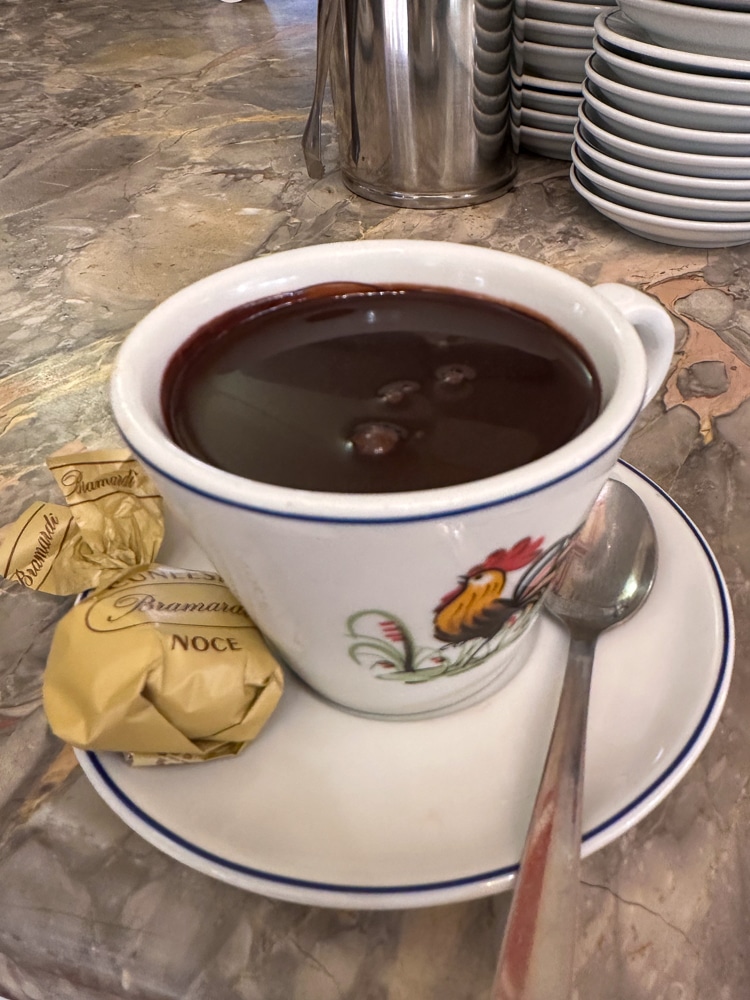
With your Piemontese lunch settling in and after taking in the views from the top of the Mole Antonelliana, you might be craving a little pick-me-up. If this is the case, there’s no better time to indulge in some world-famous Turin chocolate.
Luckily, there are 3 famous chocolate shops within minutes of each other and close to your next stop! To position yourself for a mini-DIY chocolate tour, make the 10-minute walk from the Mole Antonelliana to Guido Castagna, a chocolatier known for his natural methods and commitment to sustainability. From there, you can hop to Caffarel, my favorite chocolate shop in the city, and then to Guido Gobino, one of the most historic chocolate makers in the city.
It’s up to you whether you want to visit all of the chocolate shops or just specific ones. Either way, you must try Turin’s signature Gianduiotto (also spelled Giandujotto) chocolates. These wedges are made from a unique blend of chocolate and hazelnut paste. The region of Piedmont is known for its hazelnuts so it’s only fitting that they’re part of Turin’s chocolate history.
Save room to taste different types of chocolate truffles and the layered, creamy cremino chocolates of all different flavors. If you’re visiting during the cooler months of the year, you can’t visit the city without having a Torinese cioccolata calda. It’s a mug of decadent, melted dark chocolate served with or without cream.
ProTip: When you’re in and around this area and at the Museo Egizio, you’re right next to Piazza Carignano. You may even walk into it without realizing. It’s one of the prettiest squares in Turin and is worth a look!
Stop 10: Museo Egizio
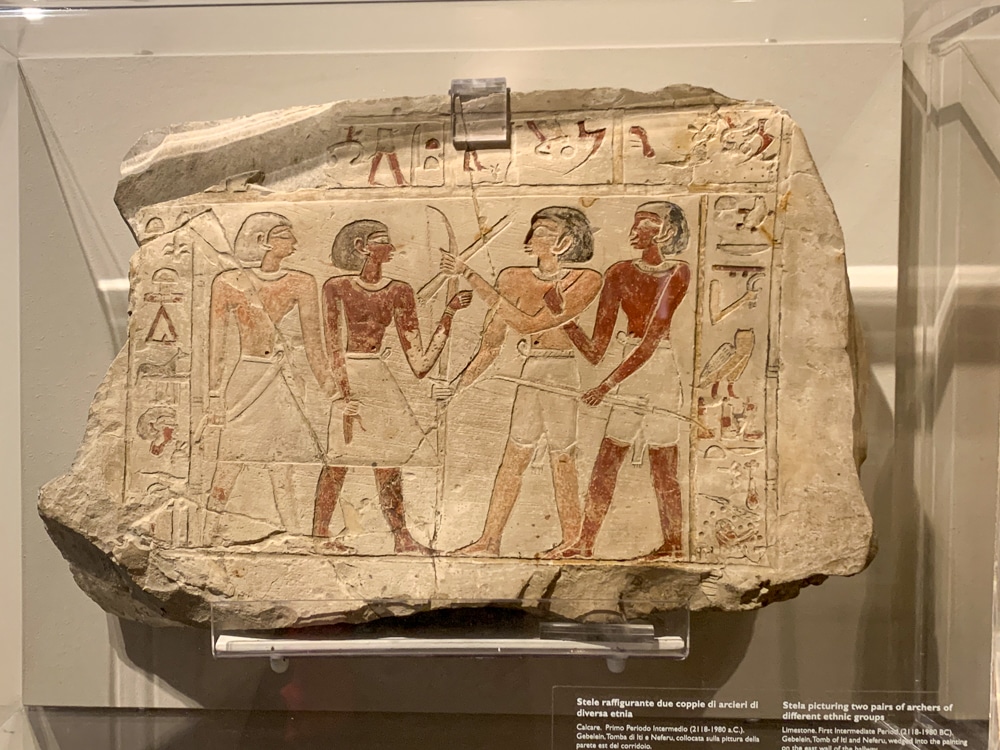
If you were feeling a little afternoon lull, no doubt the chocolate perked you up. Now, it’s off to the Museo Egizio. the best Egyptian Museum outside of visiting Egypt itself. It’s also the oldest of its kind having opened in 1824.
The museum has 36,000+ artifacts from ancient Egypt spread out over 4 floors including a significant collection of mummies and impressive Ramses II statues. The fascinating tomb of Kha (a royal architect) and his wife Merit is on display with artifacts dating back to 1400 B.C.
This is another of the most popular things to do in Turin and often sells out. The museum requires that you book tickets online for a specific entry time. Otherwise, you’re not guaranteed entry. It’s open Tuesday through Sunday from 9:30 a.m. to 6:30 p.m. On Mondays, the museum is only open from 9 a.m. to 2 p.m.
Given this and the structure of this one day in Turin itinerary, I recommend booking one of the later afternoon entry time slots. From Tuesday through Sunday, the last entry time slot is at 4:20 p.m.
Stop 11. Piazza San Carlo
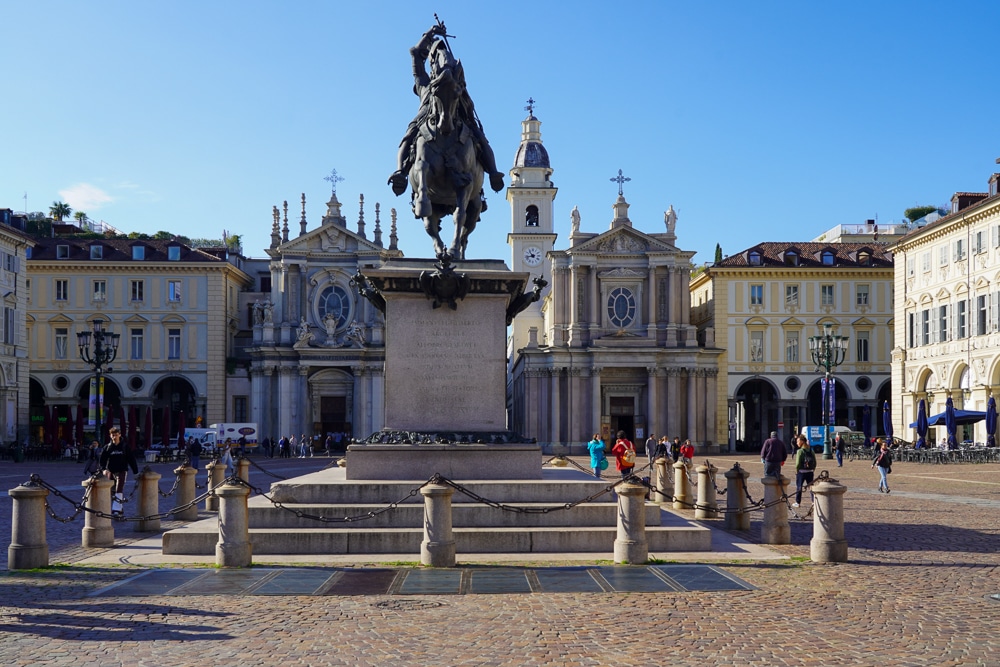
Being at the Museo Egizio also means you’re in the heart of Turin’s centro, historic center. And given that the city is known for its baroque architecture and royal Savoy history, there’s no better place to finish your day in Turin than at the elegant Piazza San Carlo.
The city’s main square is flanked by historic buildings, porticoed sidewalks, and historic cafes. Admire the “twin churches” and look for the bronze bull on the ground near Caffe Torino. It’s believed if you step in a certain spot, it’ll bring luck. Depending on the time of sunset when you visit, you might just see the lights of the piazza twinkle on. But in the warmer months, you’ll have plenty of time to enjoy this beautiful square.
In and around the Piazza San Carlo area is also the perfect place to stroll. Via Roma is a popular spot with beautiful porticoes and shopping.
Stop 12: Aperitivo & Dinner
After an incredible day in this beautiful northern Italian city, it’s time for an aperitivo and dinner. In and around the Piazza San Carlo, you’re spoiled for choice whether you’d like a glass of wine from the Piedmont hills, a spritz, or a sweet vermouth, which originated in Turin.
Then, finish the day with a classic Piedmontese dinner. Del Cambio is one of the most famous restaurants in Turin with its Michelin star and gorgeous dining room. It was also featured in Stanley Tucci’s “Searching for Italy” series and is a perfect spot if you’re looking for a sophisticated dinner at an upscale restaurant.
Scannabue is right next to Porta Nuova train station and Piola Canci is back near the Royal Palace. Both serve hearty northern Italian specialties.
Getting Around Turin
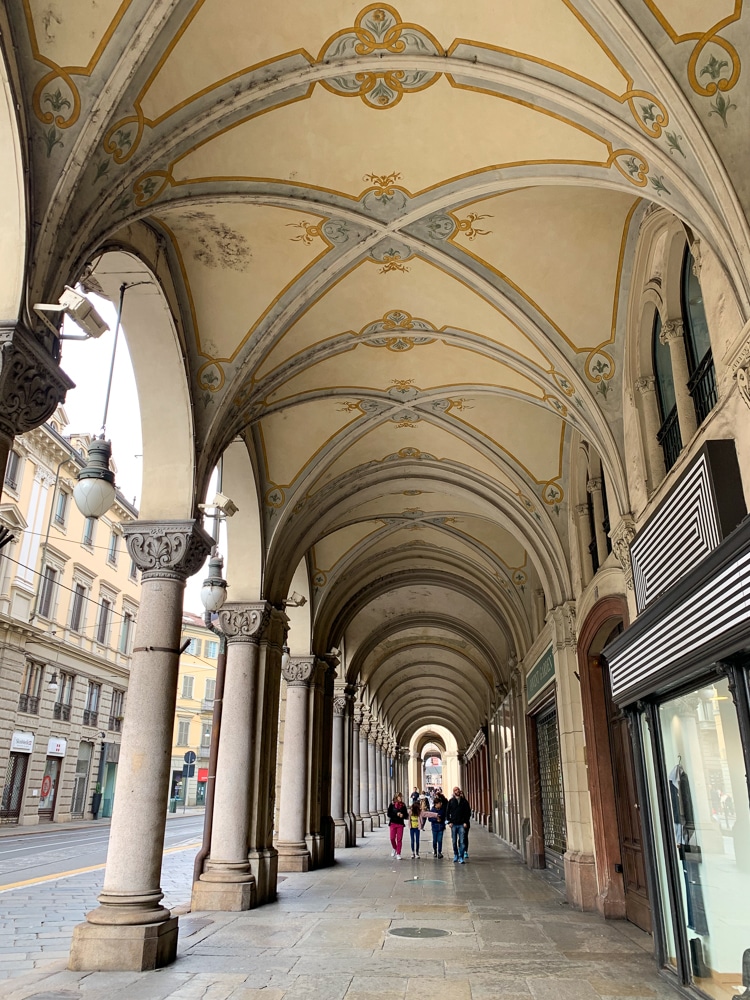
Turin is a very pedestrian-friendly city and its city center is relatively compact. Combined with the lovely porticoes to protect from the elements, the city was made for the ideal leisurely walk.
All of the places on this itinerary can be reached on foot. The city does have buses and streetcar-style trams that run throughout the center, as well as an underground metro line (M1). Single tickets cost €2 when purchased in a Metro station or at a tobacco shop and are good for 100 minutes.
Should you need public transportation for this Turin itinerary, the trams and buses could help you get around. However, keep in mind, that you might end up spending more time buying tickets and waiting for the bus or tram than it would’ve taken you to walk given the short distances between many places.
How to Get to Turin
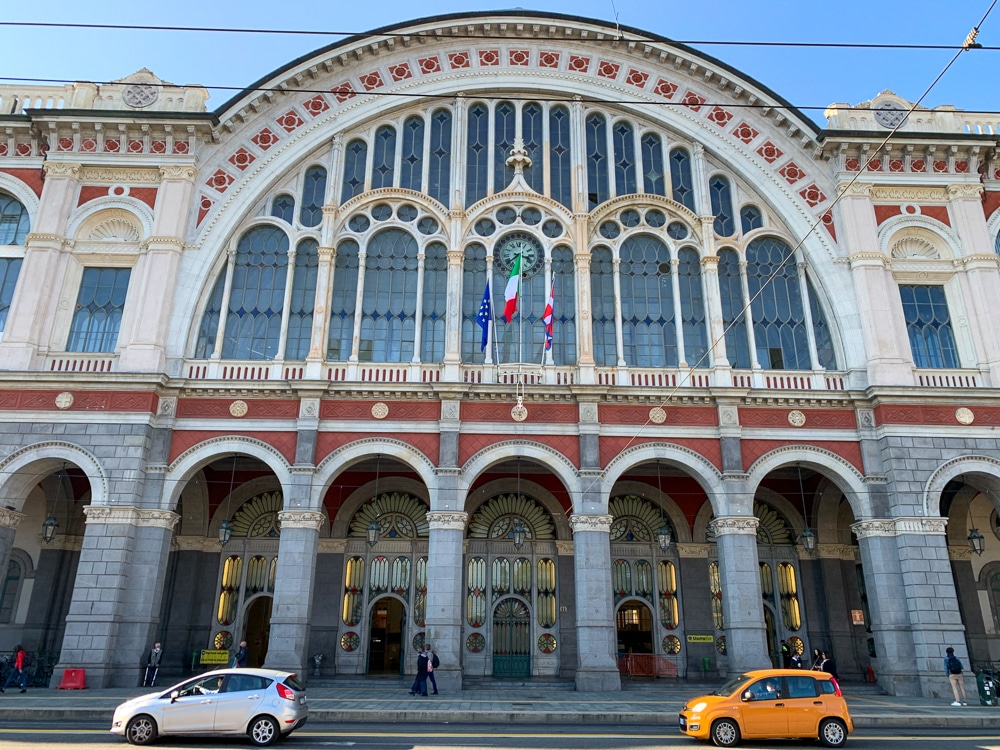
The city of Turin is well connected by Italy’s high-speed train network. Porta Nuova is the city’s main train station. Nearby Porta Susa is Torino’s other train station and just a 15-minute walk to the city center or a quick ride on the M1 Metro to Porta Nuova.
From Milan, it takes just 1 hour on Trenitalia’s Frecciarossa or Italo’s fast trains. With many trains running between the 2 cities, you can technically do a day trip. However, I really recommend staying in Turin for a night so that you can fully enjoy the city by day and night without worrying about missing your train or any possible delays. (Vice versa, too. I wouldn’t recommend taking a day trip from Turin to Milan, either.)
If you’re coming from cities further away, like Genoa or Bologna, it’ll take about 2 hours on the high-speed train, though some departures could be slightly faster or slower. Check the train schedule for the day and time you want to travel to Turin.
Turin’s airport is one of the many airports in northern Italy. There are no direct flights from North America to Turin but airlines like KLM and Air France fly from the U.S. to Turin with connections in Amsterdam or Paris.
From the Turin Airport, you can take a taxi, a bus, or a train to Porta Susa to reach the city center.
Torino is also well-connected to Italy’s autostradas (highways). By car, it’s just 1 hour and 40 minutes from Milan, 2 hours from Genoa, and 3 1/2 hours from Bologna. If you do drive, be sure you have a parking plan. The city has huge underground parking areas, most notably under Piazza San Carlo with an entrance right near Porta Nuova train station.
Where to Stay in Turin
Turin’s “centro” area is a perfect place to stay when you’re short on time. You can easily walk to the main sights on this itinerary. It’s also convenient if you’re arriving by train because Porta Nuova, the city’s main train station, borders the historic center.
You could also look at the area between the Po River and Porta Nuova or in the Vanchiglia neighborhood where you’ll find the Mole Antonelliana.
As you plan your trip to Turin, I recommend looking at these hotels.
- Turin Palace Hotel: 4-star hotel right next to Porta Nuova train station
- Hotel Principi di Piemonte | UNA Esperienze: 5-star hotel just steps from Via Roma and Piazza San Carlo
- Residenza dell’Opera: studios and apartments just steps from Centro
- NH Collection Torino Piazza Carlina: 4-star hotel 5 minutes on foot from the Museo Egizio
Ready to Plan Your One Day in Turin?
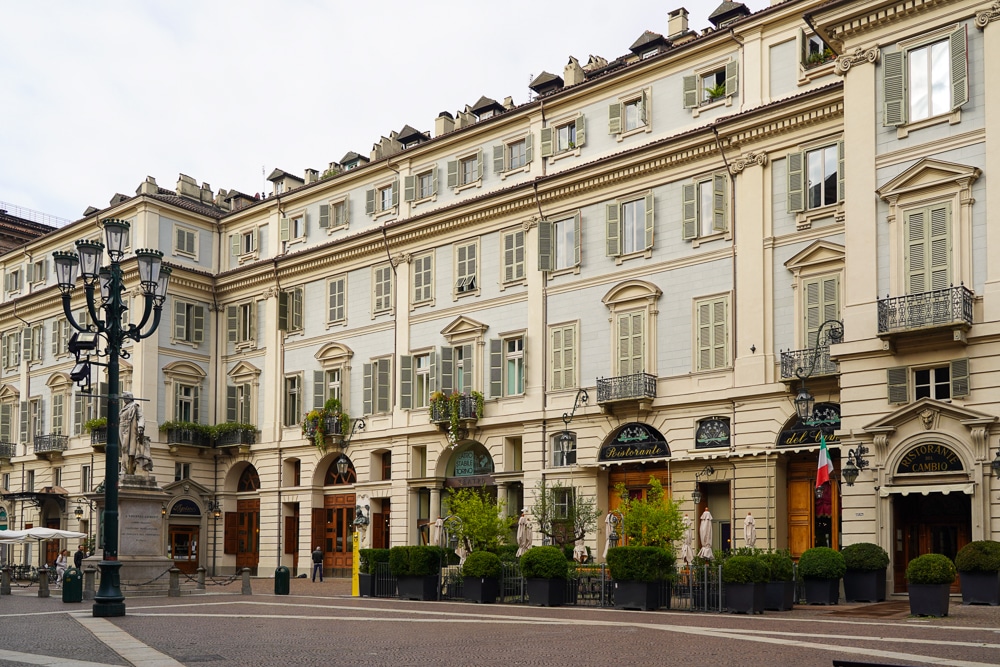
Turin is one of those Italian cities that just pulls you in! With its rich history, historic cafes, and beautiful architecture, it’s a great place to spend a single day…and more if you can.
I’m hardly objective because I’m head over heels for Torino but no northern Italy itinerary is complete with a visit here. And you never know, this beautiful city just might end up being the surprise favorite of your Italy trip!
So, what are your questions about planning a day in Turin?
Like this post? Please share it on social media using the share buttons.

Love love your One day Turin; btw you and “finding Alexxi” blogs, you make it easier for me to plan my wife’s and my Switzerland and northern Italy trip — we have done Venice, Florence, Tuscany, Napoli, pompei, Amalfi, capri, and Rome but not Lake Como, bologna, Dolomites or Turin —- this summer we are doing Zurich->.lucenrne -> interlaken//muren/grindenwald/wegen -> Zermatt -> glacier express to st mortiz -> como at Tremezzo -> then it gets difficult…gotta fly out…don’t wanna stay in Milan so wanna do a day trip to Turin but now thinking — como thru Milan (no stop!!) to Turin and spend 2 nights; love your one day itinerary and wrote it all down — I hope we could do your one day trip after traveling from como thru Milan to Turin — may have to break it up; but as foodies and wine lovers, we have to get to Piedmont wine country and drink all the Nebbiolo we can — so do we need a full day of that or b/c of travel time, do we break up your “one day” Turin into the day of travel and then 1/2 the next day at at 11am or so, go to wine country? Then the following day, fly out back to Dallas Texas via Paris or London?
Thanks so much for reading, Clay. You’re planning an amazing trip! I’d say 1/2 in Turin and then some morning time the next day is likely what’s going to work best for your itinerary. From Como San Giovanni train station, it takes about 2 – 2 1/2 hours (with a connection through Milan) to get to Turin by train. By the time you drop bags at your hotel etc. and assuming you took a morning train, you’d have from around (or just before) lunch onward. Piemonte is the perfect spot for foodies and wine lovers. I would plan to do an organized activity to do some wine tasting if only to maximize time and allow someone to handle the logistics to make sure it all goes smoothly. Thanks again for reading!