
From the moment I had my first taste of real Pesto alla Genovese in Liguria, the region in northern Italy where Genoa is located, I was obsessed!
Who was responsible for this pure genius? Did this perfect green sauce come about by chance or was it methodically worked out with try after try in some ancient kitchen?
Not one to sit still when such a fixation takes hold, I’m not ashamed to admit that I dove into the research rabbit hole with the sole mission of uncovering the origins of pesto. Along the way, I found some answers that satisfied my curiosity. (Although, incidentally, my cravings for pesto only intensified.)
Andiamo! Let’s find out more about this classic northern Italian sauce together.
What is the meaning of pesto?
I’m a word nerd. I like to look at the root of a word and see what clues I can find about its meaning, past and present. So, this seemed like a logical place to start in my quest for pesto’s origins. I used my developing understanding of the Italian language and my experience with romance languages to make sense of what I found.
The word “pesto” comes from the Italian verb “pestare” which evolved from the Latin word “pistare.”
“Pestare” and “pistare” both mean to pound or crush something. They also mean to grind, beat, pulverize, step on, and trample.
If you know even the basics about pesto, you know the basil leaves need to be pounded or crushed so this made sense. It also meant that from the earliest origins of pesto, it must have referred to something that needed to be pounded or grinded. It’s not a far leap from here to imagine someone long ago with their mortar and pestle (a.k.a. the first food processor) crushing basil leaves or other herbs.
And I’m sure it’s not lost on you either that the word “pestle” also has its roots in the Latin “pist-” which refers to the word “pounded.”
So, what are the origins of pesto?
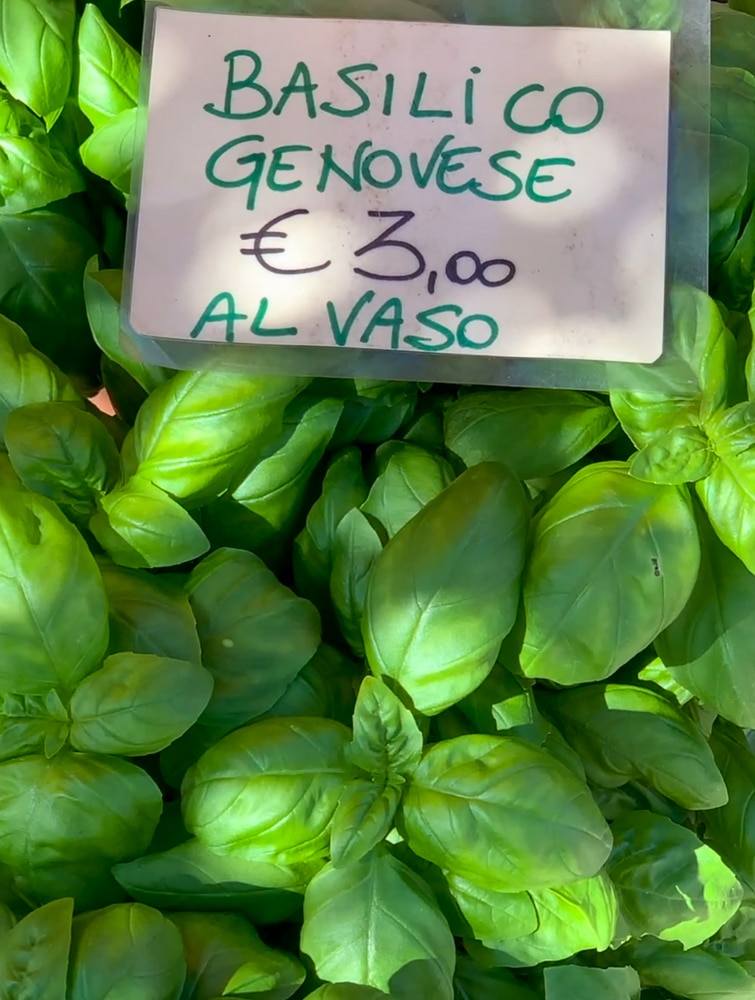
One of the biggest surprises came when I realized basil wasn’t from Italy or even Europe. Today, it’s such a prominent herb in many dishes from north to south that it’s hard to imagine Italian food without it!
So, where did basil come from? How did it get to Italy? And did it lead to a sauce like the pesto we know today or did something come before it?
Turns out, early versions of a pesto-like dip go back to ancient Rome. They made an herb paste known as “moretum.” This early concoction involved mixing fresh cheese with various herbs, oil, vinegar, salt, and pepper. Instead of basil, herbs like parsley, mint, coriander, celery, and even other greens were used during Roman times.
The name “moretum” struck me because of its similarity to the word “mortar” so I double-checked its Latin history. Come to find out, it roughly means “salad” which made some sense given it’s a mix of greens. To make moretum, though, it needed to be pounded in a mortar and pestle just like pesto. (And just for the record, mortar comes from the Latin “moratium” and translates to a “receptacle for pounding” or a “product of grinding or pounding.”)
So essentially, it all boils grinds down to this. Ancient Romans made a crushed herb “salad” which was more like a dip or spread, using a mortar and pestle. Served with bread, it was a simple vegetarian dish. In fact, there’s a poem in the Appendix Vergiliana, a collection of poems likely from the 1st century AD, called “Moretum” where a peasant farmer is described as grinding cheese, garlic, and herbs in a mortar, mixing it with some oil, and eating it with bread.
Interestingly, too, a Roman writer named Columella who lived during the 1st century AD also wrote about different recipes for moretum in Book XII of his De re rustica. One variation includes pine nuts which are also part of our modern-day pesto recipe.
Where did pesto come from?
Even though the Romans knew about basil, they had negative beliefs about it. That is until it was used as a sign of love by young women looking for matches. In other ancient civilizations, basil was used in after-death rituals or for medicine.
Basil itself likely comes from India and Southeast Asia. Over time, it traveled to the west towards the Middle East and Europe via the spice route.
Meanwhile, during the Middle Ages, the Genovese were making another pesto ancestor known as “agliata.” It was a sauce made from mashed garlic and walnuts. Add to this a legend that swirls about a friar who lived in a convent in Prà, a neighborhood on the outskirts of western Genoa and ironically dubbed the capital of Basil today, who used the herb with a few ingredients like garlic and nuts to make a pesto.
So, while there’s speculation and some breadcrumb clues that close cousins of the pesto we know and love today were taking shape in the city of Genoa, it wasn’t until the 1850s when the first written recipe for modern-day pesto was recorded.
Emanuele Rossi’s recipe appeared in La Cuciniera Genovese in 1852 to be exact. It called for basil, garlic, Parmigiano, pine nuts, and even a little butter to be crushed into a paste and mixed with oil, and served over pasta. After a few recipe tweaks, traditional Pesto alla Genovese became the star of Ligurian cuisine.
What is Pesto alla Genovese D.O.P?

Once basil was introduced, it flourished in Mediterranean climates.
So it makes sense that Liguria’s mild, sunny weather and rich soil on the hills overlooking the Mediterranean Sea were perfect for growing basil, the cornerstone of authentic Genovese pesto. Yes, basil can be grown in many places, but Ligurian basil is known for its small, tender leaves and that to-die-for flavor that can’t be matched anywhere else.
Just like Parmigiano Reggiano, balsamic vinegar, and famous wines have specific rules and requirements to carry a special name, Pesto alla Genovese has a special status in Italy and Europe known as D.O.P. (Denominazione di Origine Protetta), or Protected Designation of Origin.
This means that only pesto made with specific ingredients and following a traditional method can be called Pesto alla Genovese. To qualify, the main ingredients must include fresh basil leaves grown in specified areas in Genoa.
Authentic Pesto alla Genovese must also use Ligurian extra virgin olive oil. Pine nuts add to the creamy texture, while the fresh garlic brings the bite that balances the basil’s sweetness. Finally, the cheese blend typically combines Parmigiano-Reggiano and Pecorino Sardo for that hint of saltiness.
(Who else’s mouth is watering?!)
All this is to say that D.O.P. status isn’t just a label. It’s a promise that the Pesto alla Genovese you’re getting is a product that follows in the authentic footsteps that pesto took on its historic journey to perfection.
Dishes with Pesto in Liguria
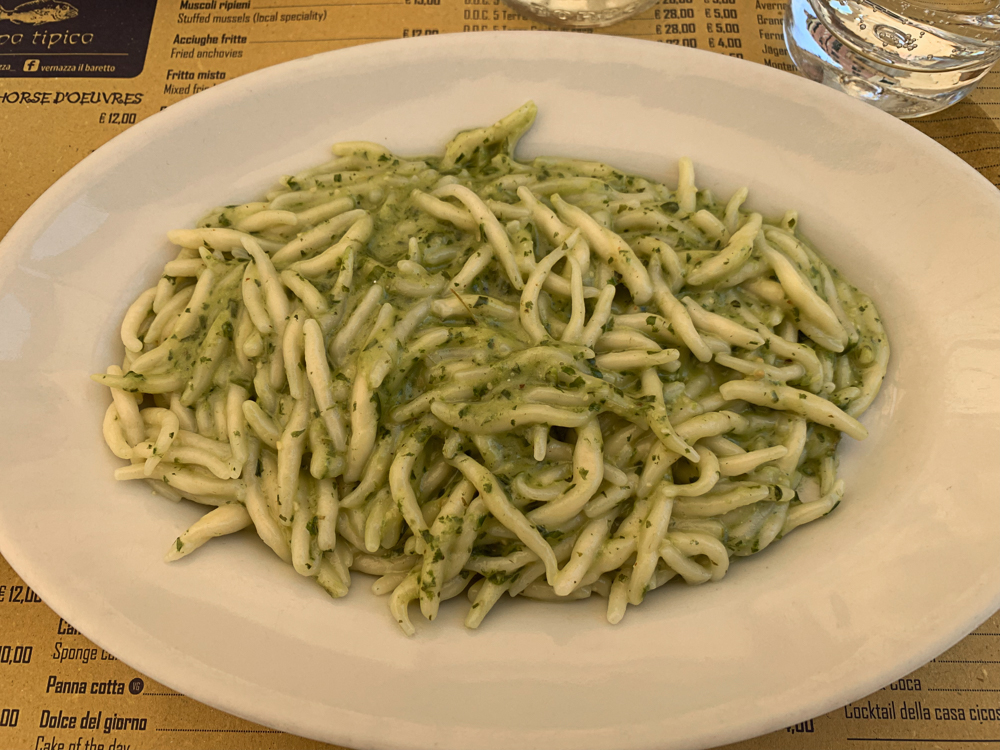
Exploring the Liguria region of Italy isn’t just about soaking in the stunning coastal views and checking off top sights; it’s also about indulging in as much traditional basil pesto as your body will allow! Don’t be surprised, either, if your pasta dish comes with green beans or potatoes. They’re traditional with pasta and pesto in Liguria. Here are some must-try dishes.
- Trofie al Pesto: A thin, twisted pasta in a classic pesto sauce. It’s a must-have dish in Liguria!
- Trenette al Pesto: Similar to linguine and tossed in a luscious pesto sauce.
- Ravioli alla Genovese: Filled with a savory mixture of cheese and herbs or meat and served with a drizzle of pesto sauce.
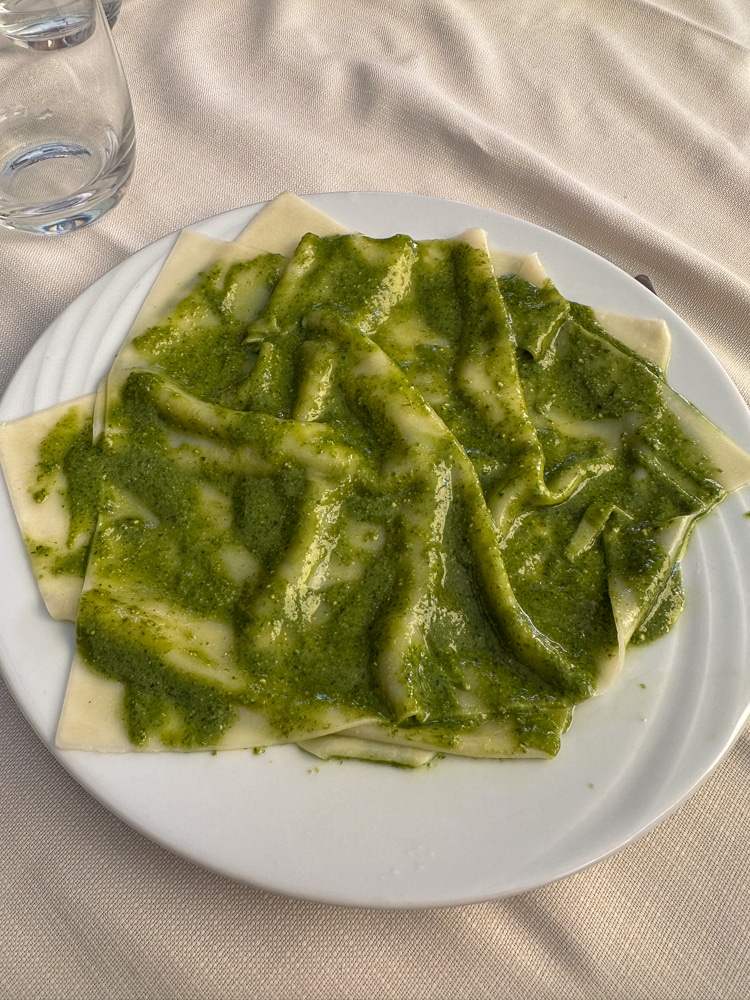
- Mandilli de Sea al Pesto: This translates to “silk handkerchiefs,” referring to the thin sheets of pasta that resemble delicate fabric. These silky pasta sheets are generously coated in velvety pesto sauce. I love this unique pasta and how it pairs perfectly with pesto!
- Gattafin: A Ligurian specialty similar to a savory pie, filled with a mixture of cheese, Swiss chard, and sometimes meat or fish. Pesto is added to enhance the flavors.
From Ancient Recipe to Traditional Italian Sauce
The history of Pesto follows a long and winding road from Ancient Rome to India and the tropical regions of southern Asia to points along the spice route and ultimately the city of Genoa, in the northern Italian region of Liguria.
Now with each forkful of this wonderful sauce, we can savor its simplicity and be amazed by the combination of chance and trial and error that delivered it to our taste buds!
